Living Off-Grid in Nigerian Solar Estates: Real Maintenance Costs and Savings
If you have lived in Lagos, Abuja, or Port Harcourt over the last three years, you already know the drill. You are sitting in your living room, enjoying a cool breeze, and suddenly—up NEPA!—the power cuts out.
Within two seconds, the hum of thirty different noise-polluting, smoke-belching generators fills the air across the neighborhood.
By the time you factor in fuel prices pushing over ₦1,200 per liter, buying petrol or diesel every single week feels like paying a second house rent. It is no surprise that thousands of Nigerian home buyers and tenants are actively turning away from conventional neighborhoods toward a solar estate in Nigeria.
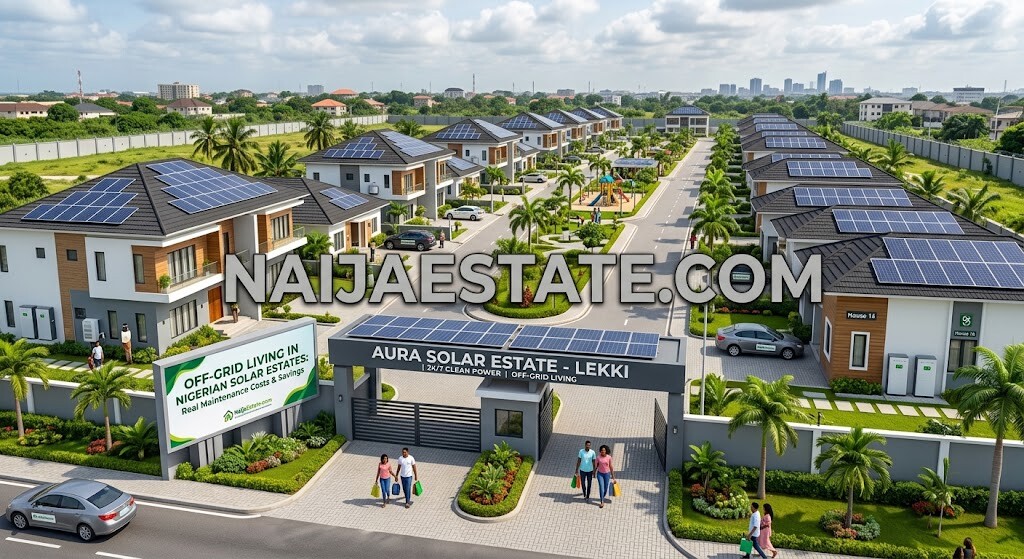
Developers know this craving all too well. Take a drive through the Lekki-Epe expressway, Sangotedo, Ibeju-Lekki, Eleyele in Ibadan, or the fast-growing corridors of Lugbe in Abuja. You will see massive billboard adverts screaming:
"Buy Your Dream Home in Nigeria's Premier 100% Off-Grid Solar Estate! 24/7 Uninterrupted Clean Power! Zero Generator Noise!"
It sounds like absolute paradise, doesn't it? No fuel queues, no generator mechanic trouble, no sudden blackout mid-Zoom call.
But as an active real estate consultant and field investigative reporter for NaijaEstate.com, I always tell prospective buyers one thing: There is no such thing as completely free energy.
While escaping the public grid and generator noise is liberation, living off-grid comes with its own financial realities. Before you make that heavy deposit or pack your bags into a self-sustaining housing development, you need to know the true, unvarnished off-grid solar estate maintenance cost in Nigeria.
In this exhaustive breakdown, we will unpack the hidden service charges, real battery replacement timelines, maintenance realities, and the exact ROI you should expect from an off-grid solar estate in Nigeria.
1. What Exactly Is an Off-Grid Solar Estate in Nigeria?
To understand where your money goes every month, you must first understand how these estates are architected from an engineering and estate management standpoint.
In Nigeria today, developers implement solar integration in two distinct ways:
A. Centralized Utility Mini-Grid Estates
In a centralized setup, the estate developer builds a massive, industrial solar farm on a dedicated plot inside the estate. They set up industrial hybrid inverters, massive lithium battery banks, and run underground distribution cables directly to every home's pre-paid meter.
You do not own the panels on the roof or the batteries in the power house. The estate management acts as your localized utility company. You simply purchase power tokens through an app or facility management portal.
B. Decentralized Individual Roof-Mounted Estates
Here, the developer builds the housing unit and equips each property with its own standalone solar system—typically ranging from 5kVA to 10kVA hybrid inverters with 5kWh to 15kWh lithium storage. The equipment belongs to you (or is bundled into your home purchase price/lease agreement), and you are directly responsible for its upkeep and routine servicing.
+-----------------------------------------------------------------------+
|                    OFF-GRID SOLAR ESTATE ARCHITECTURES               |
+-----------------------------------------------------------------------+
|                                                                       |
|   CENTRALIZED MINI-GRID                 DECENTRALIZED INDIVIDUAL      |
|   +-----------------------+             +-----------------------+     |
|   | Solar Farm & Battery  |             | Solar Panels & System |     |
|   | House (Estate Shared) |             | (On Your Own Roof)    |     |
|   +-----------+-----------+             +-----------+-----------+     |
|               |                                     |                 |
|               v                                     v                 |
|     Underground Cables                    Direct Home Wiring          |
|               |                                     |                 |
|               v                                     v                 |
|   Pre-Paid Meter Billing                Homeowner Maintains           |
|   (Facility Service Charge)             (Individual Upkeep)           |
+-----------------------------------------------------------------------+
While centralized setups offer simplicity, decentralized setups offer independence. However, both models carry recurring costs that many buyers completely overlook during marketing presentations.
(Looking for legal safeguards before buying estate land or houses? Make sure to check our guide on resolving family land disputes in Nigeria and legal steps before you build.)
2. The Direct Realities: Operational Costs You Cannot Escape
Let’s dismantle the illusion that off-grid living means "zero electricity costs."
When you live off-grid, your capital expenditure (CapEx) shifts into operating expenditure (OpEx). Here are the primary operational expenses that make up the off-grid solar estate maintenance cost in Nigeria.
1. Panel Cleaning and Environmental Maintenance (Dust & Soot)
Nigeria’s climate presents unique environmental challenges for solar generation. During the harmattan season (November to February), thick layers of dry Sahara dust settle over solar arrays. In urban centers like Lagos and Port Harcourt, air pollutants and soot from heavy traffic combine with dust to coat panel surfaces.
Efficiency Drop: Dirty panels can experience a efficiency reduction between 15% and 30%.
Cost: Estate management or independent technicians charge between ₦15,000 and ₦35,000 per cleaning session for a residential rooftop installation.
Frequency: Minimum of 4 to 6 cleanings annually to maintain optimal peak wattage generation.
2. Inverter Servicing, Dust Extraction, and Firmware Upgrades
Modern hybrid solar inverters (such as Growatt, Felicity, Sunsynk, or Deye) are complex, high-power electronic devices. They pull in ambient air to cool their internal transformers and MOSFET circuitry.
Over 12 to 18 months, dust accumulates inside the casing, clogging cooling fans and causing heat buildup that leads to unexpected shutdowns or short-circuit failures.
Cost of Preventive Maintenance: ₦25,000 to ₦50,000 per service visit (includes cleaning internal heat sinks, checking terminal torque, verifying string voltages, and updating firmware).
Cooling Fan Replacements: Internal high-speed cooling fans wear out every 2 to 3 years, costing roughly ₦15,000 to ₦30,000 to replace.
+-------------------------------------------------------------------------+
| ANNUAL PREVENTIVE MAINTENANCE BREAKDOWN (5kVA SYSTEM) |
+-------------------------------------+-----------------------------------+
| Maintenance Activity | Average Annual Cost (NGN) |
+-------------------------------------+-----------------------------------+
| Rooftop Panel Washing (4x/Year) | ₦80,000 - ₦120,000 |
| Inverter Internal Cleaning & Check | ₦35,000 - ₦50,000 |
| Cable & Terminal Thermal Inspection | ₦20,000 - ₦30,000 |
| Surge Protector / Earthing Audit | ₦15,000 - ₦25,000 |
+-------------------------------------+-----------------------------------+
| TOTAL ESTIMATED ANNUAL UPKEEP | ₦150,000 - ₦225,000 |
+-------------------------------------+-----------------------------------+
3. The Elephant in the Room: Battery Replacement Cycles and Costs
When calculating the long-term off-grid solar estate maintenance cost in Nigeria, energy storage is where 70% of your maintenance reserve fund will go over a 10-year period.
Many home buyers assume solar batteries last forever. They do not. Every battery chemistry has a finite cycle life measured in Depth of Discharge (DoD).
+------------------------------------------------------------------------+
|                   BATTERY LIFESPAN & COST COMPARISON                   |
+----------------------+--------------------+----------------------------+
| Battery Technology   | Expected Lifespan  | Typical 2026 Replacement   |
+----------------------+--------------------+----------------------------+
| Tubular / Gel        | 2 to 4 Years       | ₦220,000 - ₦380,000 / unit |
| Lithium (LiFePO4)    | 8 to 12 Years      | ₦1.5M - ₦4.8M / module     |
+----------------------+--------------------+----------------------------+
Lead-Acid / Tubular / Gel Batteries
If your developer cut costs by installing traditional 200Ah 12V tubular or gel batteries, prepare yourself mentally. In typical Nigerian daily discharge cycles (discharging 70% to 80% nightly), these batteries degrade significantly within 24 to 36 months.
Replacing a small 4-battery bank of 200Ah tubular batteries will cost between ₦880,000 and ₦1,400,000 every 3 years.
Lithium Iron Phosphate (LiFePO4) Batteries
Most premium modern solar estates now utilize Lithium (LiFePO4) storage walls. Lithium batteries offer an impressive 4,000 to 6,000 cycle life at 80% DoD, translating to roughly 8 to 12 years of reliable daily service.
However, when the replacement cycle finally arrives, the financial commitment is substantial:
A 5kWh Lithium Wall-Mount Battery costs between ₦1,500,000 and ₦2,600,000.
A 10kWh Lithium Battery Bank costs between ₦3,200,000 and ₦4,800,000.
Expert Field Insight: If you live in a solar estate in Nigeria, you must establish a "Battery Sinking Fund" from Day 1. Put aside ₦30,000 to ₦45,000 every month into a dedicated yield-bearing account. When your lithium battery bank reaches the end of its operational lifecycle after 8 to 10 years, you will have the full replacement capital ready without straining your family finances.
4. Case Study: My 12-Month Living Experience in a Sangotedo Solar Estate
To give you first-hand, real-world data rather than theoretical estimates, let me share data from an investigative case study I tracked over 12 months.
I monitored a 3-bedroom semi-detached duplex located in a fully off-grid residential estate in Sangotedo, Ajah, Lagos.
System Setup:
Inverter: 5kVA / 48V Hybrid Solar Inverter
Solar Array: 10 x 550W Monocrystalline Panels (5.5kWp total array)
Storage: 10kWh Wall-mounted LiFePO4 Lithium Battery
Occupants: Family of 4 (2 adults working remotely, 2 school-age children)
Connected Heavy Loads: 1 Inverter Air Conditioner (1.5 HP run during peak sunshine hours), 1 Inverter Refrigerator, Water Pump (1 HP), Smart TVs, Lighting, and Laptops.
+------------------------------------------------------------------------+
|          CASE STUDY: 12-MONTH OFF-GRID RUNNING COSTS (SANGOTEDO)       |
+---------------------------------------------------+--------------------+
| Expense Category                                  | Total Amount (NGN) |
+---------------------------------------------------+--------------------+
| Routine Rooftop Panel Cleaning (Quarterly)        | ₦100,000           |
| Inverter Thermal Service & Wiring Audit           | ₦45,000            |
| Replacement of Blown DC Surge Protector           | ₦28,000            |
| Estate Centralized Backup Generator Surcharge     | ₦180,000           |
| Contribution to Battery Sinking Reserve Fund      | ₦420,000           |
+---------------------------------------------------+--------------------+
| TOTAL 12-MONTH OPERATIONAL EXPENDITURE            | ₦773,000           |
+---------------------------------------------------+--------------------+
The Unfiltered Takeaway:
The household spent ₦773,000 in total operational expenses over 12 months (inclusive of their battery replacement reserve allocation).
Compare this to their previous rental residence in Ikeja GRA, where they were spending over ₦280,000 monthly on generator petrol and Disco bills combined—totaling a staggering ₦3,360,000 per year!
Living in a solar estate in Nigeria saved this family over ₦2.5 Million in cash flow within a single year, even after budgeting responsibly for long-term battery replacement!
+-----------------------------------------------------------------------+
|             ANNUAL EXPENDITURE COMPARISON (SANGOTEDO STUDY)           |
+-----------------------------------------------------------------------+
|                                                                       |
|   PREVIOUS IKEJA GRA HOME (Petrol Gen + Grid)                         |
|   ==============================================> ₦3,360,000/Year     |
|                                                                       |
|   SANGOTEDO OFF-GRID ESTATE (Solar OpEx + Reserve)                    |
|   =======> ₦773,000/Year                                              |
|                                                                       |
|   NET ANNUAL SAVINGS: ₦2,587,000 CASH IN HAND!                        |
+-----------------------------------------------------------------------+
5. Centralized Service Charges: What Estate Developers Don't Highlight
If you move into a estate with a centralized mini-grid, your costs will look slightly different. Instead of managing rooftop panels directly, you will pay a monthly Facility Management Service Charge.
Here are the breakdown items commonly found in centralized solar estate service charge statements:
1. Diesel Auxiliary Reserve Charge
What happens when rain falls continuously for three days straight during the peak of July? Solar generation drops by up to 70%. Centralized solar estates maintain heavy industrial standby diesel generators (250kVA - 500kVA) to bridge power generation gaps during prolonged cloudy periods. You will pay a monthly standby capacity fee whether the generator runs or not.
2. High-Voltage Distribution Maintenance
Transformer oil filtration, underground feeder cable repairs, and joint box servicing are handled by estate engineers. These expenses are baked into your service charge or levied as special maintenance assessments.
3. Commercial Electricity Tariff Tariffs
In centralized estates, developers charge per kilowatt-hour (kWh). As of 2026, off-grid estate mini-grid tariffs range from ₦180 to ₦260 per kWh. While higher than Band A public grid tariffs, it remains vastly cheaper than self-generated generator power (which exceeds ₦450 per kWh equivalent).
(Operating property or short-lets across major Nigerian hubs? Stay compliant by reading our detailed breakdown on New Lagos Short-Let Regulations: What Host Operators Must Know to Avoid Sealing.)
6. How to Calculate Your Real ROI Before Buying into a Solar Estate
Before you sign a contract of sale for a property in a solar estate in Nigeria, use this practical step-by-step framework to determine if the numbers make financial sense:
+-----------------------------------------------------------------------+
|                 REAL ESTATE SOLAR ROI FORMULA FRAMEWORK               |
+-----------------------------------------------------------------------+
|                                                                       |
|   STEP 1: Calculate Previous Annual Energy Spend (Petrol + Grid)      |
|   STEP 2: Calculate Projected Solar Estate OpEx + Reserve Allocation  |
|   STEP 3: Subtract Solar OpEx from Previous Spend = Annual Savings    |
|   STEP 4: Divide Solar System Premium by Annual Savings = Payback Years|
|                                                                       |
+-----------------------------------------------------------------------+
Step 1: Calculate Your Baseline Energy Spend
Calculate what you spent on grid bills, generator purchasing, fueling, engine oil, and mechanic repairs over the last 12 months.
Step 2: Calculate the Off-Grid Estate System Premium
Ask the developer for a line-item breakdown showing the cost attributed to the solar infrastructure. For instance, if a standard 3-bedroom duplex costs ₦75 Million without solar and ₦81 Million with an installed 5kVA lithium solar package, your Solar Capital Premium is ₦6 Million.
Step 3: Compute Your Simple Payback Period
If your annual energy savings (like our Sangotedo case study) equal ₦2.5 Million per year, divide your ₦6 Million capital premium by ₦2.5 Million:
Within less than two and a half years, your solar system has completely paid for itself! Every year after that represents pure profit and dramatically reduced cost of living.
7. Crucial Red Flags to Inspect Before Signing the Contract
To ensure your dream home doesn't turn into an unexpected money pit, conduct thorough due diligence on the estate's solar infrastructure.
+-----------------------------------------------------------------------+
|                  SOLAR ESTATE BUYER CHECKLIST                         |
+-----------------------------------------------------------------------+
| [ ] Verified Brand Warranties (Inverter, Panel, Battery Tier-1)       |
| [ ] Individual Inverter Load Segregation & Isolation Breaks           |
| [ ] Dedicated Rooftop Access for Panel Washing & Maintenance          |
| [ ] Pre-installed Surge Protection & Copper Earthing System           |
| [ ] Written Service Level Agreement (SLA) on Facility Maintenance     |
+-----------------------------------------------------------------------+
Key Red Flags to Watch For:
Unbranded / OEM Components: If the developer uses unbranded white-label inverters or non-Tier-1 panels without verifiable factory warranties, run! You will spend millions on early replacements.
Undersized Battery Storage: A 5kVA inverter paired with a tiny 2.5kWh lithium battery is an unbalanced design. It will leave you in darkness by 1:00 AM if you run standard household loads. Insist on a minimum of 1kWh storage for every 500W of planned evening load.
No Lightning / Surge Protection: Nigerian coastal regions experience heavy thunderstorms. If the developer failed to install dedicated DC surge protective devices (SPD) and proper copper rod grounding, a single lightning strike can ruin your inverter instantly.
Vague Facility Management SLAs: Ensure the Service Level Agreement clearly specifies who pays for battery replacements in a centralized solar mini-grid!
(Interested in innovative housing construction and cost reductions? Check out our viral analysis on Shipping Container Homes in Lagos: The True Cost and Build Breakdown.)
Final Verdict: Is Living in a Nigerian Solar Estate Worth It?
Without a shadow of a doubt: YES.
While the upfront purchase cost of a property in a solar estate in Nigeria is higher, and you must budget responsibly for ongoing off-grid solar estate maintenance cost in Nigeria, the long-term lifestyle and financial advantages are unmatched.
You gain:
Mental Peace: No late-night petrol runs or fighting with generator mechanics.
Health Benefits: Clean air, quiet environments, and no toxic carbon monoxide fumes.
Massive Cash Flow Protection: Insulation against rising fuel prices and unpredictable grid tariff hikes.
Superior Capital Appreciation: Properties inside quiet, self-sustaining solar estates appreciate up to 25% faster than conventional estates burdened by generator noise pollution.
The key to long-term satisfaction is simple: Do not treat solar as an set-it-and-forget-it appliance. Plan for maintenance, clean your panels quarterly, establish your battery sinking fund, and enjoy uninterrupted living!
What's Your Experience?
Are you currently living in an off-grid solar estate or considering making the move? What is your biggest concern regarding solar maintenance or service charges?
Drop your thoughts, questions, and experiences in the comments section below! Let’s discuss!