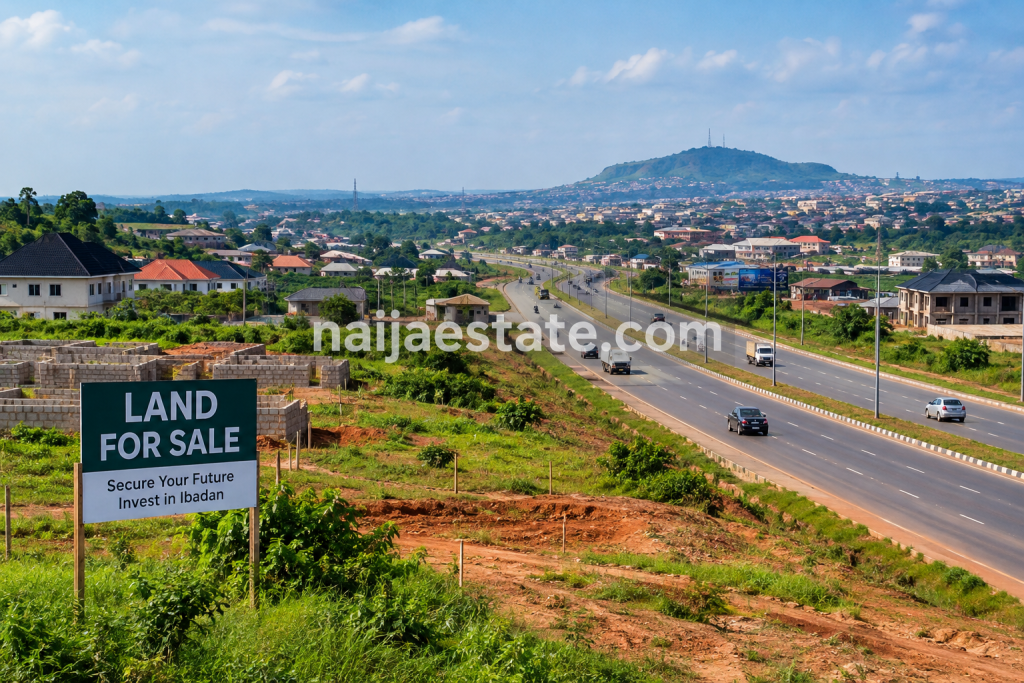
Land Banking Along the Ibadan Circular Road & Moniya: When Will Your Investment Mature?
Introduction: Is Ibadan’s Next Property Boom Worth Waiting For?
Imagine buying a plot of land on the outskirts of Ibadan today, keeping it for five or ten years, and eventually selling it for a price that could help you build a house, expand your business, or fund another investment. That is the idea behind land banking, and it is attracting attention from property buyers looking beyond the expensive neighbourhoods of Oyo State’s capital.
Two locations that deserve a closer look are the Ibadan Circular Road corridor and Moniya, particularly as investors assess infrastructure development, road accessibility, and the possibility of future demand.
However, here is the question many buyers fail to ask before making payment: when will the investment actually mature, and what if the expected development takes longer than planned?
The truth is that buying land in Ibadan is not automatically a profitable investment. Location, title documents, purchase price, development timelines, and your ability to hold the property all influence the final outcome.
In this guide, we examine practical land banking strategies Ibadan Circular Road Moniya investors can use, realistic holding periods, potential costs, risks, and the steps to take before committing your money. We will also explore why infrastructure announcements should inform your decisions without becoming the only reason you buy.
Whether you live in Ibadan, are planning to relocate to the city, or want to invest in land while living elsewhere in Nigeria, this guide will help you approach the opportunity with clearer expectations.
What Is Land Banking, and Why Does It Matter in Ibadan?
Land banking involves purchasing land with the intention of holding it for an extended period while waiting for its market value or usefulness to increase.
Unlike buying a completed house and collecting rent every month, land banking usually produces no regular income. Your potential return comes primarily from selling the land later at a higher price, although some parcels may support agricultural, commercial, or other lawful uses depending on their location and applicable restrictions.
For example, a buyer might purchase a properly documented plot in an emerging part of Ibadan, retain ownership for several years, and sell when demand from homebuilders or businesses increases.
The important word is might. Appreciation is not guaranteed, and the length of time required to achieve a satisfactory return can be difficult to predict.
Why Ibadan attracts land investors
Ibadan offers a combination of established residential neighbourhoods, commercial districts, educational institutions, transport connections, and developing peripheral communities.
Areas such as Bodija, Akobo, Oluyole, Apata, Ido, Moniya, and communities around the Circular Road corridor serve different property markets. Their prices, accessibility, infrastructure, and demand drivers are not identical.
A buyer who cannot afford a well-located plot in an established neighbourhood may consider a developing corridor instead. The trade-off is that cheaper land may require a longer waiting period before it attracts sufficient demand.
This is where land banking becomes relevant.
Rather than paying a premium for an already-developed location, the investor is making a calculated decision about where future housing, commercial activity, and infrastructure might create demand.
Nevertheless, a developing location is not necessarily a good investment simply because it is affordable. The land must have a defensible title, a realistic purchase price, suitable access, and a plausible path to future demand.
Why the Ibadan Circular Road Corridor Is Attracting Attention
The Senator Rashidi Ladoja Circular Road project is an important infrastructure development to consider when evaluating land around Ibadan.
Radio Nigeria Ibadan reported on 18 August 2026 that Oyo State’s Acting Governor, Bayo Lawal, described the project as a catalyst for development across six local government areas: Oluyole, Ido, Egbeda, Ona-Ara, Lagelu, and Akinyele. The report stated that approximately 32 kilometres of dual carriageway had been completed and asphalted at the time, with streetlights and toll gates installed. It also reported that arrangements had been made to compensate affected landowners who had registered. These were project updates reported in August, not a guarantee of subsequent completion or an assurance that every nearby property would benefit equally.
Source: Radio Nigeria Ibadan — Circular Road, catalyst for development.
How road infrastructure can influence land values
Major roads can influence property markets in several ways.
Improved accessibility: Places that previously required difficult or time-consuming journeys may become more attractive when road connections improve.
Commercial opportunities: Better transport links can support distribution, warehousing, retail, and other businesses where demand and planning conditions permit.
Residential expansion: Households may consider locations that offer a workable balance between housing costs, transport, and access to employment or services.
Developer interest: Estate developers may become more interested in areas where access and demand appear promising.
Changes in land use: Some locations may attract residential, commercial, or mixed-use proposals, subject to planning approval and the relevant land-use rules.
These factors can support property demand, but they do not affect every parcel in the same way.
Land close to an access road, for instance, may attract commercial interest, while a plot farther inside a community may appeal more to residential buyers. In some circumstances, traffic, noise, drainage problems, road setbacks, or restrictions on access can reduce the attractiveness of particular parcels.
The sensible approach is to evaluate the actual plot rather than assume that everything described as being “along the Circular Road” will appreciate at the same rate.
Does buying near the Circular Road guarantee profit?
No.
Infrastructure development is a potential demand driver, not a promise of investment returns.
The market may already have priced in some expected improvements. Sellers who believe the road will transform their neighbourhood may increase their asking prices before the benefits become fully visible.
If you pay an inflated price based on expectations, you could end up waiting for years before a buyer is willing to pay more than you did.
There is also a difference between land that is near a major road and land that benefits directly from it. Access arrangements, drainage, legal boundaries, acquisition issues, and the distance to usable junctions can all affect the practical value of a plot.
Before purchasing, identify the exact location, visit the site, confirm the boundaries with a registered surveyor, and establish whether any road reservation, acquisition, or other restriction affects the land.
Why Moniya Deserves a Separate Investment Analysis
Moniya is another location worth examining when considering land banking in Ibadan.
The Moniya-Iseyin Road corridor has attracted attention from property marketers and prospective buyers who are interested in land outside the city's more established residential districts.
A review of property listings on Private Property Nigeria on 15 October 2026 showed asking prices of approximately ₦1 million for one advertised plot at Itura Gardens Phase I and ₦1.425 million for a plot at Mercyland Estate Phase 4. Other listings on the same platform carried substantially different asking prices.
Source: Private Property Nigeria — Land for sale in Moniya, Ibadan.
These figures are examples of advertised prices, not independently verified sale prices or a comprehensive valuation of Moniya. Plot dimensions, title status, estate infrastructure, payment terms, and exact locations can differ significantly. Listings may also become outdated.
Still, the variation illustrates an important lesson: there is no single price for land in Moniya.
What could drive future demand in Moniya?
Investors should consider several potential demand drivers.
Transport and connectivity: Road access can influence whether a location works for residents, traders, and businesses. Buyers should assess the actual journey from a proposed plot to important destinations rather than rely solely on a developer's description.
Housing affordability: Some buyers may consider peripheral locations when established neighbourhoods become too expensive for their budgets. However, affordability must be assessed alongside transport expenses, available services, and the cost of preparing the land for development.
Commercial activity: Areas with credible prospects for business growth may attract demand for shops, storage facilities, workshops, and other commercial properties. Such prospects should be supported by observable activity rather than marketing promises alone.
Population and household growth: More households can create demand for housing, but growth does not automatically translate into higher land prices in every community.
Infrastructure delivery: Roads, electricity, water, drainage, schools, and healthcare services can make an area more attractive when they are actually available and suitable for residents.
A responsible investor should separate existing conditions from planned improvements. A road that is already usable is different from a proposed road whose funding, delivery date, or alignment remains uncertain.
Circular Road versus Moniya: Which is better for land banking?
Neither location is automatically superior.
The Circular Road corridor covers a broad area, so its investment characteristics depend on the particular section being considered. Moniya also contains a variety of neighbourhoods, estates, and parcels with different levels of accessibility and development.
A useful comparison is to ask what you are paying for today and what must happen before another buyer will be willing to pay more.
For a Circular Road parcel, investigate the road's actual alignment, access arrangements, nearby development, and any acquisition or planning restrictions.
For a Moniya parcel, examine access to established roads, nearby occupied properties, services, local demand, and whether the asking price already reflects the growth story being promoted.
The better investment is the one with a sound title, an appropriate purchase price, manageable holding costs, and a credible future market—not necessarily the one with the most exciting advertisement.
Land Banking Strategies Ibadan Circular Road Moniya Investors Should Understand
The best land banking strategy is not simply to buy the cheapest plot and wait for the area to become popular. It is to buy a property that other people are likely to want in the future, at a price that leaves room for a reasonable return after expenses.
Here are seven practical strategies worth considering.
1. Buy based on real demand, not just future promises
Before buying land, identify the people who might eventually purchase it from you.
Could your future buyer be a family planning to build a bungalow? A small business owner looking for a shop or warehouse? A property developer assembling land for a residential project?
Each buyer has different requirements.
A family may prioritise access roads, drainage, electricity, schools, and neighbourhood security. A business may care more about road frontage, visibility, traffic access, and planning permissions.
The clearer you are about your potential future buyer, the easier it becomes to judge whether a plot is worth holding.
For example, imagine two plots advertised at the same price around Moniya. One is accessible from a usable road and sits near occupied homes. The other is several kilometres from established services, with no dependable access during the rainy season.
The second plot might eventually appreciate, but it could take longer to attract a buyer. A small difference in the purchase price may not compensate for the additional uncertainty.
2. Investigate the immediate neighbourhood
Do not stop your inspection at the estate entrance.
Walk around the area and observe what is happening.
Look for:
Completed houses and homes currently under construction.
Residents who live in the neighbourhood throughout the year.
Shops, schools, healthcare facilities, and other useful services.
Existing electricity connections and practical water sources.
Road conditions during wet and dry weather.
Drainage channels, low-lying ground, and evidence of flooding.
Construction materials, active building sites, and signs of genuine demand.
Ask residents how long they have lived there and whether access has improved or deteriorated.
A neighbourhood with occupied homes and functioning services may provide more evidence of existing demand than an estate where most of the plots remain empty. However, neither condition alone proves that the land is fairly priced.
3. Compare prices beyond the estate's own sales office
Suppose a marketer tells you that a plot costs ₦2 million today but will sell for ₦8 million within three years.
Before accepting the projection, investigate similar plots nearby.
Compare their sizes, access, title documentation, development status, and actual transaction evidence where available.
Ask independent estate agents, registered valuers, and property owners about recent sales. Where possible, distinguish completed transactions from asking prices and informal estimates.
If an estate is charging a significant premium, find out what justifies it. Is the road already developed? Are drainage and electricity available? Is the title position clearer? Are the plots genuinely more accessible?
If there is no convincing answer, the price may reflect marketing rather than underlying value.
4. Consider a staged investment strategy
You do not necessarily need to buy several plots at once.
A buyer with a limited budget may choose one properly verified plot and retain enough money for legal work, documentation, unexpected expenses, and other financial commitments.
This approach reduces the danger of tying too much money to a single property market.
For example, someone who spends nearly all their available savings on three plots may struggle if a family emergency arises or if the properties take longer than expected to sell.
Another investor may buy one plot, keep an emergency reserve, and review the investment after two or three years.
The second approach does not guarantee a higher return, but it can make the investment easier to manage.
5. Treat title verification as part of the investment
A cheap plot with defective ownership documents is not a bargain.
Before making payment, establish who owns the land, whether the seller has the legal right to transfer it, whether the title is affected by competing claims, and whether the proposed use is permitted.
In Oyo State, the Ministry of Lands, Housing and Urban Development provides official information and services for land documentation. The state's Digital Land Survey Plan Registry also allows members of the public to search for survey-plan records.
Use the official Oyo State Digital Land Survey Plan Registry as one part of your due diligence.
Importantly, a matching survey record does not by itself prove ownership or establish that a parcel is free from acquisition, disputes, or other restrictions. The government specifically advises that survey verification does not replace a legal title search and physical verification.
For a substantial purchase, engage an independent property lawyer and a registered surveyor. Do not depend exclusively on documents supplied by the seller or estate marketer.
6. Calculate your likely exit costs before buying
Many first-time investors focus entirely on the purchase price.
But the amount you pay when acquiring the property is not necessarily the total amount you will have invested by the time you sell.
Consider:
Legal fees and title-search expenses.
Surveying and boundary verification.
Applicable registration and documentation charges.
Estate development or infrastructure levies.
Ground clearing and basic site maintenance.
Security expenses where applicable.
Taxes and transaction costs, as confirmed by qualified advisers.
Selling and marketing expenses.
These expenses can materially reduce the profit you make when the property is eventually sold.
If you cannot estimate the likely costs of owning and selling a plot, you cannot properly estimate its investment return.
7. Write down your exit plan before purchasing
Ask yourself three questions before signing an agreement:
Under what circumstances would I sell?
How long can I comfortably hold the land without receiving income?
What will I do if prices remain flat for several years?
Your exit plan might involve selling after a target holding period, selling when a credible offer reaches a particular net-return threshold, or retaining the land for a future home.
Do not make the plan depend entirely on a government project being completed by a specific date. Infrastructure schedules can change, and property demand may respond differently from what investors expect.
When Will Your Land Banking Investment Mature?
This is the central question for anyone investing along the Ibadan Circular Road or around Moniya.
There is no official maturity date for land banking. Unlike a fixed-term deposit with a specified end date, land does not become profitable automatically after three, five, or ten years.
The investment matures financially when you can realise an acceptable return, taking all expenses and the time value of your money into account.
For planning purposes, investors can examine several hypothetical holding periods.
| Holding period | What to monitor | Main consideration |
|---|---|---|
| 1–2 years | Infrastructure delivery, resale interest, and price changes | Short holding periods leave less time to absorb transaction costs |
| 3–5 years | Occupied homes, services, commercial activity, and comparable sales | Development may improve demand, but appreciation remains uncertain |
| 5–10 years | Wider urban growth, changing land use, and long-term demand | A longer wait may be necessary, but does not guarantee profit |
| Beyond 10 years | Continued suitability, title security, and alternative uses | Reassess whether retaining the land still makes financial sense |
These are planning scenarios, not forecasts for either location. A particular parcel could appreciate sooner, remain unchanged for years, or lose value relative to inflation and other investments.
A practical way to estimate your return
Consider an illustrative example.
You buy a plot for ₦1,500,000. Your legal, surveying, documentation, and other acquisition expenses total ₦150,000.
Your initial investment is therefore ₦1,650,000.
Five years later, you sell the property for ₦2,500,000. Assume your selling expenses total ₦100,000.
Your net proceeds after selling expenses are ₦2,400,000.
Your estimated profit before any applicable taxes or other unaccounted-for costs is:
₦2,400,000 − ₦1,650,000 = ₦750,000.
That is a nominal return of approximately 45.5% on the initial investment over five years.
However, that figure does not account for inflation or the opportunity cost of having your money tied up in land.
It also assumes you can actually sell for ₦2.5 million and complete the transaction at the estimated cost. Those assumptions must be tested against market evidence.
Why nominal profit can be misleading
Suppose your land sells for more than you paid, but prices for building materials, labour, transport, and other essentials have risen substantially during the same period.
Your investment has produced a nominal gain, but the purchasing power of that gain may be much smaller than expected.
This is particularly important for people buying land because they eventually want to build a house.
Your real objective may not be to increase the number of naira in your bank account. It may be to secure a residential plot, reduce the future cost of building, or preserve purchasing power.
For that reason, compare the estimated net return with inflation and with realistic alternatives available to you. A qualified financial adviser can help you assess the implications for your wider financial position.
The Hidden Costs of Land Banking in Ibadan
A land banking investment can appear attractive until the additional expenses begin to accumulate.
Documentation and professional fees
Land transactions may involve legal advice, title searches, survey verification, agreement preparation, registration, and other applicable charges.
The exact amounts depend on the property, the transaction, the documentation already available, and the services required.
Request a written estimate before making payment. Do not assume that the price advertised by an estate developer includes every necessary expense.
Estate development levies
Some estates collect money for roads, drainage, security, or other infrastructure.
Ask what each levy covers, whether it is compulsory under your agreement, when payment is due, and whether additional charges may arise later.
Read the estate's documentation carefully instead of relying on a verbal promise that everything will be completed before you begin building.
If you eventually live in the property, ongoing estate charges may also affect your household budget. NaijaEstate has a related guide on unreasonable estate security levies in Nigeria and what resident associations can legally do.
Site maintenance and security
Vacant land can be difficult to monitor, particularly when the owner lives far away.
Depending on the circumstances, you may need periodic inspections, boundary maintenance, clearing, or other lawful measures to protect your interests.
Do not assume that paying an estate developer or caretaker automatically removes every risk of encroachment or competing claims.
Keep your documents secure, maintain a record of inspections, and investigate any report of a boundary dispute promptly.
The cost of waiting
Money invested in land is money that may not be available for other purposes.
If you spend your emergency savings on a plot and later need funds for healthcare, school fees, business expenses, or housing, you may be forced to sell at an unfavourable price.
Land is also less liquid than cash. Finding a serious buyer and completing a property transaction can take time.
Before investing, consider whether you can afford to hold the property without relying on an urgent sale.
How to Avoid Land Scams Around the Circular Road and Moniya
The risk of buying land with defective documentation or disputed ownership deserves serious attention.
A persuasive salesperson, attractive estate gate, or impressive brochure cannot replace independent verification.
1. Confirm the seller's authority
Ask for the seller's identity, ownership documents, and evidence of the legal authority to sell.
If the property is being sold by an agent, family representative, company, or attorney, have your lawyer establish whether the person has the necessary authority.
Where land belongs to a family or involves an estate, additional questions may arise about the people whose consent or participation is legally required. These issues should be resolved before payment.
2. Conduct an independent title search
Do not accept a photocopy of a Certificate of Occupancy as conclusive evidence that a seller has a clean title.
A Certificate of Occupancy, deed, survey plan, allocation letter, or other document must be assessed in its legal and factual context.
Your lawyer should investigate the root of title, the seller's interest, relevant registry records, and any potential competing interests or restrictions.
The precise checks required will depend on the nature of the property and the documents presented.
3. Inspect the land physically
Visit the actual parcel with a registered surveyor.
Confirm that its boundaries correspond with the documents and that the land being shown is the same land being sold.
Ask about access, drainage, neighbouring claims, encroachments, and any signs that the parcel may be affected by a road reservation or government acquisition.
Do not conclude the purchase simply because an agent has shown you an attractive site plan on a phone.
4. Do not pay under pressure
Be cautious when a marketer insists that you must transfer money immediately because the price will double tomorrow or the last plots are about to disappear.
A genuine opportunity should withstand reasonable due diligence.
Use a documented payment process, obtain receipts, and ensure that the sale agreement accurately records the parties, property description, consideration, and relevant obligations.
5. Understand the difference between a survey record and ownership
Oyo State's online survey registry is a useful tool, but its purpose has limits.
The government explains that a matching survey-plan record does not establish that the person presenting it is the current owner. It also does not guarantee that the land is free from acquisition, restrictions, or disputes.
If a search produces no result, that does not automatically mean the document is fake either. The record may not yet have been digitised, or the information entered may be incorrect.
Follow up with the appropriate government office and qualified professionals instead of drawing conclusions from one online search.
6. Keep records after payment
Retain copies of your signed agreement, receipts, survey plan, title documents, correspondence, and any estate payment records.
Where applicable, complete the necessary registration or perfection processes with professional guidance.
Keep a clear record of the precise parcel purchased, not merely the estate name or the name used in an advertisement.
How NaijaEstate Can Help You Research Ibadan Property Opportunities
Choosing land for long-term investment requires more than finding a seller with an attractive price.
You need to compare locations, understand the property market, identify the questions that matter, and obtain independent professional advice before committing your money.
NaijaEstate's property and real estate coverage can help readers become better informed about the issues affecting property decisions in Ibadan. You can explore related updates through the NaijaEstate news section.
The aim is to make property research more accessible, so prospective buyers can approach conversations with estate developers and agents with better questions.
For example, rather than asking only, “How much is one plot?”, ask:
What is the exact plot size?
What is the current title status?
Are the advertised infrastructure facilities already available?
What additional charges will I have to pay?
How far is the land from a usable public road?
What comparable properties have actually sold recently?
What restrictions could affect building or resale?
A few additional questions before payment can help you avoid expensive mistakes later.
A Simple Land Banking Checklist for Ibadan Buyers
Before purchasing around the Circular Road or Moniya, work through this checklist.
Visit the exact plot and confirm its location.
Engage an independent registered surveyor.
Have a property lawyer investigate ownership and title.
Check relevant government records and any acquisition or planning restrictions.
Confirm the land's permitted use.
Inspect road access, drainage, and the surrounding neighbourhood.
Compare asking prices and seek evidence of completed transactions.
Calculate acquisition costs, ongoing expenses, and likely selling costs.
Identify the type of buyer who may want the property in the future.
Decide how long you can comfortably hold the land.
Keep sufficient money available for emergencies.
Obtain signed documentation and traceable payment records.
If you cannot complete the essential checks, delay the purchase. Missing out on a plot is usually less damaging than committing your savings to land you cannot safely own or resell.
Final Verdict: Is Land Banking Around Ibadan Worth It?
Land banking around the Ibadan Circular Road and Moniya may be worth considering if you have a long investment horizon, can afford to leave your money untouched, and can identify a properly documented parcel at a sensible price.
The Circular Road project creates a reason to investigate locations that may benefit from improved connectivity. Moniya offers a different opportunity to assess developing neighbourhoods, transport access, affordability, and potential future demand.
But neither location should be treated as a guaranteed shortcut to wealth.
Your success will depend on the specific land you buy, the price you pay, the quality of the title, the cost of holding the property, and whether genuine buyers emerge when you are ready to sell.
Remember that land banking does not generate a profit simply because time has passed. An investor who buys too expensively may struggle to earn a satisfactory return even if the neighbourhood develops.
The smarter strategy is to research carefully, verify independently, calculate every major expense, and make decisions based on evidence rather than excitement.
For Ibadan residents hoping to secure land for their children, prepare for retirement, build a future home, or diversify their investments, patience can be useful—but patience must be combined with sound judgement.
What is your opinion? Would you rather invest in land around the Ibadan Circular Road or buy a plot in Moniya? Do you believe a three-to-five-year holding period is realistic, or would you prefer to hold your land for ten years or longer? Share your thoughts and experiences in the comments.
Editorial note: This article provides general property-investment information, not a guarantee of appreciation or a substitute for professional legal, surveying, valuation, or financial advice. Advertised property prices are not necessarily completed transaction prices. Verify current conditions before investing.