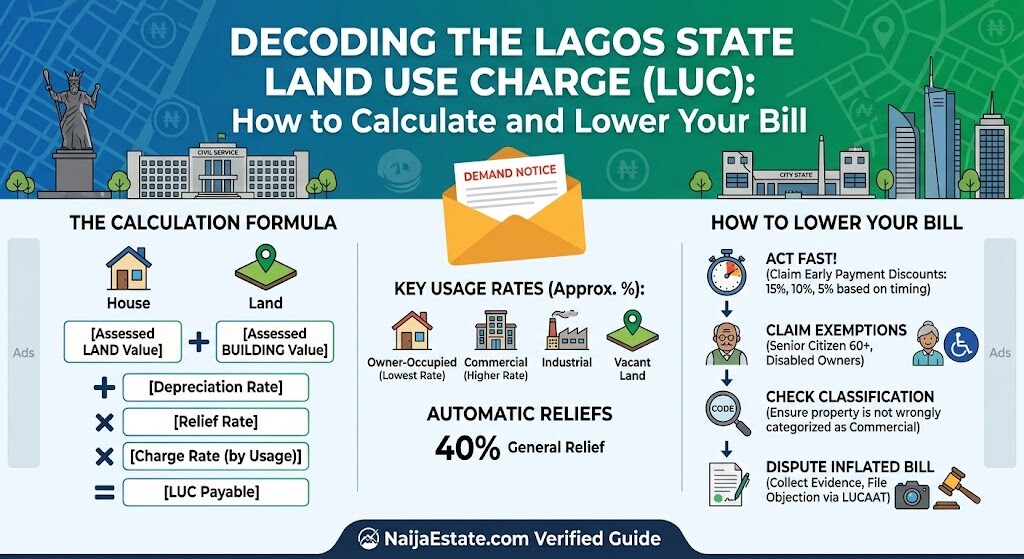
Lagos Land Use Charge Explained: How Property Owners Can Avoid Overpaying
Whether you just completed a sleek duplex in Lekki Phase 1, inherited a family bungalow in Surulere, or bought a plot of land in Ibeju-Lekki, there is one annual envelope every Lagos property owner fears in their mailbox. That yellow-tinted demand notice from the Lagos State Government bearing the title Lagos Land Use Charge.
For many landlords and real estate investors across Nigeria, opening this demand notice often feels like a jump scare. You might see a figure running into hundreds of thousands—or even millions—of Naira for a property that isn't even generating monthly commercial rent. Immediately, confusion sets in: “How did they arrive at this figure? Did they mistake my residential house for a hotel? How do I pay this without emptying my bank account?”
Understanding the Lagos State Land Use Charge calculation guide is not just an advantage; it is a financial survival skill for every real estate owner in Lagos State. In this comprehensive guide, we will break down the exact mathematical formula used by the state, reveal hidden legal discounts, explain how to dispute inflated bills, and show you practical steps to legally lower your bill before the deadline hits.
What is the Lagos State Land Use Charge (LUC)?
To put it simply, the Lagos Land Use Charge is a consolidated property-based tax established under the Land Use Charge Law of Lagos State. Introduced initially in 2001 and subsequently revised—most notably under the reformed Land Use Charge Law of 2020—it consolidates three major property taxes into one single annual bill:
Property Tax
Tenement Rate
Ground Rent
Before this consolidation, property owners were hounded by local government officials for tenement rates, while state officials demanded ground rent and land taxes separately. The LUC was designed to streamline this process so that property owners make one single, transparent payment annually to the Lagos State Government.
The revenue collected through the LUC directly funds public infrastructure—from the expansion of the Lekki-Epe Expressway and drainage projects in Ikeja to municipal security operations. However, while the government relies on these funds for civic projects, property owners often suffer because of inaccurate assessments, outdated property classification, or simply failing to claim their lawful tax relief allowances.
Who is Required to Pay the Land Use Charge?
A common point of dispute among property occupiers across Lagos is determining who bears the legal responsibility for paying the bill: the landlord or the tenant?
According to the Lagos State Land Use Charge Law, the liability for paying the charge rests primarily on the legal owner of the property. However, the law also states that where the owner cannot be traced or is absent, the legal occupier (such as a long-term commercial or residential tenant) can be served the notice and held liable to pay. In practice, tenants who settle the LUC bill on behalf of their landlords usually deduct the amount from their subsequent annual rent, provided proper receipts and documentation are preserved.
+-----------------------------------------------------------------------+
|                       LUC TAXABILITY OVERVIEW                         |
+-----------------------------------------------------------------------+
|  PROPERTY TYPE          |  TAXABLE STATUS     |  APPLICABLE RATES     |
+-------------------------+---------------------+-----------------------+
|  Owner-Occupied Res.    |  Taxable            |  Lowest Relief Rate   |
|  Commercial Property    |  Taxable            |  Standard Commercial  |
|  Industrial / Factory   |  Taxable            |  Industrial Rate      |
|  Vacant Unimproved Land |  Taxable            |  Bare Land Rate       |
|  Palaces & Places of    |  EXEMPT             |  0% (Must Register)   |
|  Public Worship         |                     |                       |
+-------------------------+---------------------+-----------------------+
How Is the Lagos Land Use Charge Calculated?
Many property owners assume the state government simply guesses a random number and prints it on the demand notice. In reality, the Lagos State Ministry of Finance uses a specific mathematical formula enshrined in the Land Use Charge Law.
Understanding this formula is the first step toward verifying if your bill was calculated correctly or over-assessed.
The Official LUC Formula
To break this down into clear terms, let us examine each component of the formula:
1. Land Value
This is calculated by multiplying the total area of your land (in square meters) by the baseline land value per square meter assigned to your specific neighborhood or zone by the state government. Naturally, land values in Ikoyi, Victoria Island, and Banana Island are rated higher than land values in Epe, Ikorodu, or Badagry.
2. Building Value
This is determined by calculating the total square meters of your building structure and multiplying it by the replacement cost per square meter for that building type (e.g., high-rise, detached bungalow, block of flats, or warehouse).
3. Depreciation Rate
The law acknowledges that buildings age over time. A 40-year-old building in Ebute Metta does not hold the same structural valuation as a newly built smart home in Lekki Phase 1. Depreciation discounts are applied based on the age, structural soundness, and maintenance level of the building.
4. General Relief Rate
To make property tax manageable, Lagos State applies a mandatory general discount across all properties. Under the revised 2020 LUC Law, the state introduced a standard 40% General Relief Rate across the board for property assessments.
5. Charge Rate
This is a specific percentage applied based on how the property is used. The law categorizes property usage into different brackets:
Owner-Occupied Residential Property: Occupied solely by the property owner and their direct family. This carries the lowest charge rate (typically around 0.035%).
Residential Property (Rented): Property rented out to residential tenants. This carries a slightly higher charge rate (around 0.070%).
Commercial Property: Used for offices, plazas, short-let apartments, hotels, and retail centers. This carries a higher commercial rate (around 0.350%).
Industrial Property: Factories and manufacturing hubs (around 0.125%).
Vacant / Unimproved Land: Undeveloped plots of land (around 0.035% to 0.200% depending on location).
Step-by-Step Calculation Example
Let us walk through a practical scenario to illustrate how this formula operates in real life.
Imagine Chief Adeleke owns a 4-bedroom detached duplex on a 600 square meter plot in Ikeja GRA. He lives in the property with his family (Owner-Occupied Residential).
Assessed Land Value for the Area: ₦50,000 per sqm
Assessed Building Replacement Cost: ₦60,000 per sqm (Total Building Floor Area = 300 sqm)
Total Land Value: $600 \times ₦50,000 = ₦30,000,000$
Total Building Value: $300 \times ₦60,000 = ₦18,000,000$
Total Property Value: $₦30,000,000 + ₦18,000,000 = ₦48,000,000$
Now, let us apply the legal reliefs and rates:
Apply 40% General Relief:
Apply Owner-Occupied Charge Rate (0.035%):
In this scenario, Chief Adeleke's base Land Use Charge for his owner-occupied home in Ikeja GRA is ₦10,080 per year.
However, if Chief Adeleke decides to convert that same property into a commercial short-let apartment or a corporate office without notifying the state, the system will categorize it under commercial charge rates (0.350%). His bill would instantly jump to ₦100,800 per year!
Understanding this distinction is critical for hosts navigating new Lagos short-let regulations to avoid property sealing and unexpected tax reclassifications.
Real Life Case Study: How Incorrect Categorization Doubled a Landlord's Bill
To highlight how common misclassification is, consider the case of Mr. Babatunde, a retired civil servant living in Yaba, Lagos.
In 2024, Mr. Babatunde received an annual LUC demand notice of ₦240,000 for his single-storey residential property. For three consecutive years, he had paid this sum, assuming it was a non-negotiable tax set by the government.
Upon reviewing his demand notice during an estate association audit, a property consultant noticed a critical mistake: the property was categorized as Commercial / Mixed Use on the government portal. The field enumerators who drove by years prior saw a small boutique sign on the outer gate wall—placed there by a short-term tenant who had moved out two years earlier—and marked the entire property as a commercial business hub.
+--------------------------------------------------------------------+
|                CASE STUDY: MR. BABATUNDE'S AUDIT                   |
+--------------------------------------------------------------------+
|  METRIC                    |  INCORRECT BILL     |  CORRECTED BILL |
+----------------------------+---------------------+-----------------+
|  Property Usage Class      |  Commercial         |  Owner-Occupied |
|  Assessed Base Rate        |  0.350%             |  0.035%         |
|  Early Payment Discount    |  Ignored (0%)       |  Applied (15%)  |
|  Senior Citizen Relief     |  Not Claimed        |  Applied (50%)  |
|  Final Annual Bill Paid    |  ₦240,000           |  ₦15,300        |
+----------------------------+---------------------+-----------------+
Mr. Babatunde gathered his proof of owner-occupancy, statutory declaration of age, and utility bills, and filed an official objection at the Land Use Charge Assessment Appeal Tribunal (LUCAAT). Following physical verification by state officials, his property was reclassified to Owner-Occupied Residential, and additional senior citizen discounts were applied.
His annual bill plummeted from ₦240,000 to ₦15,300.
This case illustrates why blindly paying your demand notice without checking the underlying classification can cost you hundreds of thousands of Naira over time.
Proven and Legal Ways to Lower Your Lagos Land Use Charge Bill
If your current LUC demand notice feels excessively high, do not ignore it or resolve to avoid payment altogether. Accumulating penalties and interest will only worsen the situation, potentially leading to property sealing or legal enforcement. Instead, use these lawful methods to reduce your bill:
1. Capitalize on Early Payment Discounts
The Lagos State Government incentivizes early tax compliance by offering steep discounts to property owners who pay promptly upon receiving their demand notice.
15% Discount: Granted if payment is made within 15 calendar days of receiving the demand notice.
10% Discount: Granted if payment is made between 16 and 30 calendar days of receiving the notice.
5% Discount: Granted if payment is made between 31 and 45 calendar days.
If you pay after 45 days, you forfeit all early-payment discounts and risk attracting late payment penalties ranging from 25% to 100% of the original charge over time.
2. Claim Special Statutory Exemptions and Reliefs
The Lagos State Land Use Charge Law provides explicit tax reliefs for specific demographics and property uses. Many property owners lose money simply because they do not apply for these reliefs:
Senior Citizen Relief: Property owners aged 60 years and above who live in their own residential property are entitled to an additional 50% discount on their assessable charge.
People Living with Disabilities (PWDs): Property owners with verified physical disabilities who reside in their properties qualify for additional relief discounts upon official application.
Long-Term Property Ownership: Owners who have lived continuously in the same residential property for over 12 years qualify for a long-tenure relief discount.
Properties Owned by Non-Profit Organizations: Buildings owned and operated by registered non-governmental organizations (NGOs), non-profit educational institutions, or public charities are eligible for full or partial exemptions, provided the property is not used for commercial income generation.
3. Verify Property Classification
Double-check the code and classification printed on your demand notice. If your property is listed as Commercial or Mixed-Use, but you strictly reside there with your family, you are being overcharged. Submit an official request for re-assessment to update your property profile to Owner-Occupied Residential.
4. Challenge Inflated Property Valuation
Government field enumerators sometimes use mass valuation techniques, estimating land size and building floor space from afar without measuring the exact dimensions of your property.
If your notice overstates your building's footprint or land size, hire a registered estate surveyor and valuer to conduct an independent valuation report. You can present this professional valuation to the Ministry of Finance to adjust your bill downward.
Complete List of Fully Exempted Properties in Lagos State
Not every building or land parcel in Lagos State is subject to the Land Use Charge. Under Section 12 of the Lagos State Land Use Charge Law, the following properties are 100% exempt from paying LUC:
Palaces of Recognized Obas and Traditional Rulers: Official traditional palaces and recognized heritage sites within Lagos State.
Public Places of Worship: Churches, mosques, and registered religious centers (provided the space is strictly used for worship and not for commercial activities like event centers, rented halls, or commercial schools).
Public Cemeteries and Burial Grounds: Dedicated public burial sites managed by local or state authorities.
Properties Owned by Federal, State, or Local Governments: Public schools, public hospitals, government offices, and municipal infrastructure.
Diplomatic Missions: Properties owned and occupied by foreign embassies, high commissions, and international diplomatic bodies protected under international law.
Important Note: Exemption is not automatic. If your organization falls under an exempted category but continues to receive demand notices, you must submit a formal application for exemption accompanied by your registration documents and title deeds to the Lagos State Ministry of Finance.
How to Dispute an Over-Assessed Land Use Charge (The LUCAAT Process)
If you believe your demand notice contains errors—whether due to incorrect land area measurement, wrong property usage classification, or mathematical miscalculation—you have the legal right to challenge it.
Do not ignore the bill or fight with field collectors. Follow the official dispute resolution framework provided by the Land Use Charge Assessment Appeal Tribunal (LUCAAT):
+-----------------------------------------------------------------------+
|                     OFFICIAL LUC DISPUTE TIMELINE                     |
+-----------------------------------------------------------------------+
|  STEP 1: Receive Demand Notice (Day 1)                                |
|    └─> Review calculation, area size, and usage classification        |
|                                                                       |
|  STEP 2: File Formal Written Objection (Within 30 Days)              |
|    └─> Submit letter to Commissioner for Finance with evidence        |
|                                                                       |
|  STEP 3: Official Re-Assessment & Inspection                          |
|    └─> Ministry inspectors visit property to verify physical facts    |
|                                                                       |
|  STEP 4: LUCAAT Hearing (If unresolved by Ministry)                   |
|    └─> Present case before the independent appeal tribunal            |
+-----------------------------------------------------------------------+
Step 1: Gather Your Supporting Evidence
Before filing an appeal, collect all relevant documentation to substantiate your claim:
Copy of the disputed LUC Demand Notice.
Proof of property ownership (C of O, Deed of Assignment, or Governor's Consent).
Valid Government-issued ID showing your date of birth (for Senior Citizen relief).
Photographs of the building showing its structural condition and current usage.
Independent valuation report from a registered Estate Surveyor and Valuer (if disputing property size or structural valuation).
Step 2: Submit a Formal Letter of Objection
Write a formal letter of objection addressed to the Honourable Commissioner, Ministry of Finance, Lagos State. Your letter must be submitted within 30 calendar days of receiving the demand notice.
State clearly:
The Property Identification Number (PIN) listed on the notice.
The exact grounds for your objection (e.g., incorrect property classification, inflated land size, or failure to apply senior citizen relief).
Your proposed corrected calculation based on factual evidence.
Step 3: Physical Property Verification
Upon receiving your objection, the Ministry will assign a team of certified assessors to inspect your property, measure the physical land area, verify building usage, and evaluate structural age.
Step 4: Tribunal Hearing at LUCAAT
If the Ministry fails to resolve your objection amicably, your case will be escalated to the Land Use Charge Assessment Appeal Tribunal (LUCAAT). The tribunal operates as an independent judicial body designed to resolve property tax disputes swiftly without the lengthy delays of conventional high court litigation.
What Happens If You Refuse to Pay the Land Use Charge?
Some property owners choose to ignore LUC demand notices, operating under the misconception that government enforcement is weak. However, the Lagos State Government has steadily tightened tax enforcement mechanisms.
Failing to settle your Land Use Charge without filing a valid legal objection triggers the following legal consequences:
Accrual of Late Payment Penalties:
45 to 75 Days Late: 25% penalty added to the base charge.
75 to 105 Days Late: 50% penalty added.
105 to 135 Days Late: 100% penalty added (doubling your original bill).
Property Sealing and Distraint: The Lagos State Government holds statutory powers to seal commercial premises or non-compliant properties until outstanding liabilities are settled.
Property Lien and Legal Encumbrance: Unpaid LUC liabilities attach directly to the land title as a legal charge or lien. If you attempt to sell the property or use it as collateral for a bank loan, title verification searches will flag the outstanding debt. The buyer or bank will require full settlement of accumulated arrears—plus interest—before completing the transaction.
Ensuring your property title is clean and free of hidden tax encumbrances is just as vital as resolving historical ownership rivalries. For investors navigating complex ownership structures, understanding how to handle underlying title issues is essential—especially when resolving family land disputes legally before investing heavy capital into building construction.
How to Pay Your Lagos Land Use Charge Online or Offline
Paying your Land Use Charge has been simplified through multiple official channels. Always ensure payments are made directly to authorized government accounts to avoid falling victim to fraudulent syndicates.
Option A: Online Payment via the Official Lagos State Portal
Visit the official Lagos State Land Use Charge portal (luc.lagosstate.gov.ng).
Input your unique Property Identification Number (PIN) found at the top right corner of your demand notice.
Review your bill details, owner name, and assessed amount.
Select your preferred payment gateway (Debit Card, USSD, or Net Banking).
Complete payment and immediately download your official digital payment receipt.
Option B: Payment via Designated Commercial Banks
You can pay across the counter at any designated commercial bank in Lagos State. Present your demand notice to the teller and instruct them to process the payment via the Lagos State Revenue Collection Platform (AutoReg / Remita). Ensure you collect a physical government-issued receipt printed directly from the portal system before leaving the bank hall.
Strategic Advice for Real Estate Investors and Developers in Lagos
If you manage a growing portfolio of residential rentals, commercial buildings, or off-grid housing developments in Lagos, managing annual operating expenses like tax liabilities directly impacts your net return on investment (ROI).
+-----------------------------------------------------------------------+
|                   LUC OPTIMIZATION FOR INVESTORS                      |
+-----------------------------------------------------------------------+
|  STRATEGY                 								   |  OPERATIONAL IMPACT                    |
+------------------------------+----------------------------------------+
|  1. Lease Contract Structuring 						| Explicitly state LUC responsibility  |    | in tenant agreements.                  |
|  2. Immediate PIN Registration| Register new properties early to avoid 					|               | backdated multi-year arrears.          |
|  3. Annual Portfolio Audit   | Audit demand notices every Q1 against  |     | actual physical property usage.        |
|  4. Utility & Infrastructure | Document self-funded off-grid roads &  |  Relief Claims           | power to claim infrastructure relief.  |
+------------------------------+----------------------------------------+
1. Structure Lease Agreements Clearly
When drafting tenancy agreements for commercial or multi-unit residential properties, state clearly who is responsible for paying statutory property charges. For commercial properties, it is standard industry practice to pass the LUC expense to commercial tenants as part of their annual service charge or operating expense obligations.
2. Audit Your Portfolio Annually Every First Quarter
Demand notices are typically distributed across Lagos starting in the first quarter of the year. Establish an annual audit system within your estate management team to review all received notices immediately. Verify that square meter measurements, property age classifications, and usage rates reflect reality before the 15-day early payment window expires.
3. Factor Taxes into Green & Off-Grid Development Calculations
Investors developing sustainable, off-grid communities—such as solar-powered residential estates in Ibeju-Lekki or Epe—often absorb significant initial capital expenditures to build private roads, drainage systems, and solar grids where municipal utilities are absent.
When conducting financial viability assessments for these projects, factor in statutory municipal taxes alongside operating maintenance expenses. To better understand how running costs impact long-term cash flow, read our detailed analysis on living off-grid in Nigerian solar estates, including real maintenance costs and net long-term savings.
Frequently Asked Questions (FAQs) About Lagos Land Use Charge
1. What happens if I never received a demand notice for my property?
Failure to receive a demand notice physically does not exempt you from paying the charge. As a property owner, you can visit the nearest Ministry of Finance Land Use Charge office or access the online portal with your land details to request your Property Identification Number (PIN) and generate your bill manually.
2. Can I pay my LUC bill in monthly installments?
Yes. The Lagos State Land Use Charge Law allows property owners who cannot settle their bill in a single lump sum to apply for installment payment plans. However, to maintain eligibility for early payment discounts, installment terms should be negotiated and formally approved by the Ministry of Finance within the initial notice period.
3. Is vacant, undeveloped land subject to the Land Use Charge?
Yes. Undeveloped land (often categorized as bare or unimproved land) is subject to the Land Use Charge, though it is assessed at a lower base rate compared to fully developed commercial or residential structures.
4. How long does it take for LUCAAT to resolve an appeal?
Most disputes brought before the Land Use Charge Assessment Appeal Tribunal are reviewed and scheduled for hearing within 30 to 60 days of filing, depending on the case backlog and the complexity of physical property verification required.
5. Will I be charged backdated LUC fees if I just bought an old property?
If you purchase an existing property with historical unpaid LUC liabilities, those accumulated debts remain attached to the property. It is critical to perform a thorough tax clear search with the Lagos State Ministry of Finance during title verification before finalizing any real estate acquisition to ensure the seller settles all accumulated arrears.
Conclusion
Navigating the Lagos Land Use Charge does not have to be a frustrating experience. While property tax is an inevitable obligation of property ownership in Lagos State, you should never pay more than what is legally and fairly owed.
By understanding the mathematical formula used in the Lagos State Land Use Charge calculation guide, verifying your property's usage classification, taking full advantage of the 15% early payment discount, and claiming statutory reliefs for senior citizens or long-term occupancy, you can legally keep your annual property bill as low as possible.
If you suspect your demand notice is incorrect, do not hesitate: gather your evidence, file a formal objection within 30 days, and engage the Ministry of Finance or LUCAAT through official channels.
What Has Been Your Experience with Lagos Land Use Charge?
Have you ever received an inflated Land Use Charge notice on your Lagos property? Were you able to successfully challenge or reduce your bill at the tribunal?
Share your thoughts, questions, or experiences in the comments section below! Our team of real estate experts at NaijaEstate.com will be happy to answer your questions and guide you through the process.