Ibadan Land Prices Explained: What Really Determines Value in Oyo State Real Estate
If you have ever asked a land agent why two plots of land in Ibadan have completely different prices even though they look similar, you are not alone. Many first-time buyers are confused about the factors affecting land prices in Ibadan and why a plot in one area can sell for ₦1 million while another goes for ₦20 million or more.
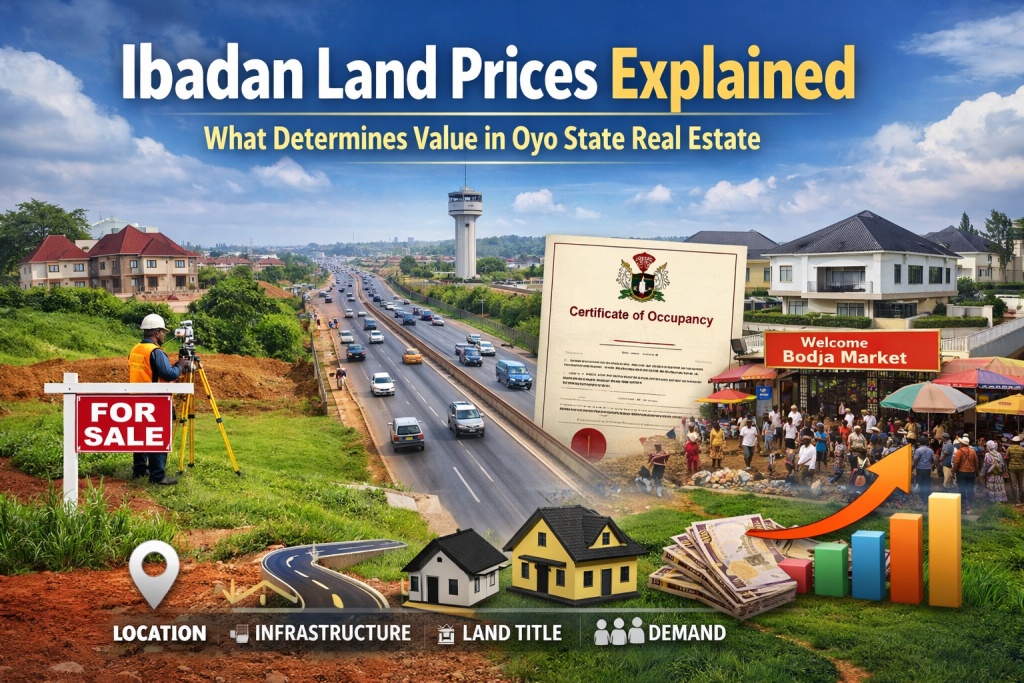
The truth is simple: land value in Oyo State is not random. Several hidden factors determine how much a plot of land costs. These factors include location, infrastructure, government policies, land titles, demand, and future development potential.
With property investment becoming more attractive across Nigeria, Ibadan is quietly becoming one of the most interesting real estate markets in the country. From new estates to infrastructure expansion and rising population, the city is experiencing steady growth.
In this detailed guide, we will break down:
The real factors affecting land prices in Ibadan
Why some areas appreciate faster than others
How land titles influence price
The role of infrastructure and government projects
Smart tips for buyers looking to invest in Oyo State real estate
Whether you are a first-time buyer, investor, or someone planning to build a home in Ibadan, this guide will help you understand how land pricing truly works.
Understanding the Ibadan Real Estate Market
Before diving into the factors affecting land prices in Ibadan, it is important to understand the nature of the city's property market.
Ibadan is one of the largest cities in West Africa by landmass, and that alone creates unique real estate dynamics.
Unlike densely packed cities like:
Lagos
Abuja
Ibadan still has large expanses of undeveloped land. This means land prices vary widely depending on development level.
For example:
| Area | Average Plot Price |
|---|---|
| Akobo | ₦15m – ₦35m |
| Oluyole | ₦8m – ₦20m |
| Moniya | ₦1m – ₦6m |
| Ido | ₦700k – ₦3m |
| Iyana Church | ₦2m – ₦8m |
These differences exist because several underlying forces shape land values.
Let’s break them down.
1. Location: The Biggest Factor Affecting Land Prices in Ibadan
The first rule of real estate anywhere in the world is simple:
Location determines value.
Within Ibadan itself, location can multiply land price by 10 times or more.
High-demand locations include:
Akobo
Bodija
Oluyole Estate
Jericho
These areas are considered premium residential neighborhoods.
Why these locations cost more
They offer:
Better road networks
Electricity stability
Security presence
Proximity to commercial zones
Access to good schools and hospitals
Meanwhile, developing areas like:
Moniya
Ido
Ologuneru
still have lower land prices because infrastructure is still growing.
But here’s the interesting part:
Many smart investors prefer these locations because early investment often leads to higher appreciation.
2. Infrastructure Development
Infrastructure is another major factor affecting land prices in Ibadan.
When government builds roads, markets, schools, or transport hubs, land values typically rise quickly.
A good example is the Ibadan Moniya corridor.
The expansion of the Ibadan–Oyo road significantly increased land demand in the area.
Similarly, development around:
University of Ibadan
has kept surrounding neighborhoods highly valuable.
Why infrastructure boosts land value
Infrastructure improves:
Accessibility
Economic activity
Population movement
Business opportunities
For investors, one key strategy is buying land before infrastructure arrives.
Once development begins, prices usually surge.
3. Land Titles and Documentation
One of the biggest pricing factors buyers often ignore is land title documentation.
Land in Ibadan may come with different legal statuses, including:
Survey plan
Deed of assignment
Registered survey
Gazette
Certificate of Occupancy (C of O)
Plots with stronger titles typically cost more.
For example:
| Land Title | Price Impact |
|---|---|
| No title | Cheapest |
| Survey plan | Moderate |
| Gazette | Higher |
| C of O | Most expensive |
A plot with a Certificate of Occupancy can cost 30–60% more than one without proper documentation.
However, the higher price often reflects lower legal risk.
4. Estate vs Community Land
Another major factor affecting land prices in Ibadan is whether the property is located in a private estate or a traditional community area.
Estate land
Land inside organized estates usually costs more.
Benefits include:
Security gates
Road layout
Drainage systems
Electricity planning
Controlled development
Examples include estates around:
Oluyole Estate
Akobo
Community land
Community land is cheaper but may require extra work like:
Road access
Documentation verification
Community settlement fees
Many buyers start with community land because it offers lower entry price.
5. Demand and Population Growth
Ibadan’s population continues to grow steadily, and this growth is pushing land prices upward.
Several factors contribute to this demand:
Migration from Lagos
Cheaper cost of living
Expansion of universities
Growth of SMEs
People moving from Lagos often see Ibadan land prices as relatively affordable.
For example:
A plot that costs ₦25 million in Lagos may sell for ₦4 million to ₦8 million in Ibadan.
This affordability attracts:
Young professionals
Developers
Diaspora investors
6. Road Accessibility
A plot of land located inside the bush without motorable road access will almost always sell cheaper.
Land connected to major roads commands higher value.
Key roads influencing land prices in Ibadan include:
Iwo Road
Challenge Roundabout
Ring Road
When a property is close to major road networks, developers consider it more attractive.
7. Commercial Potential
Land that can be used for business purposes is usually more expensive.
For example, land located near:
Markets
Schools
Fuel stations
Commercial centers
will cost more because businesses are willing to pay higher prices.
Areas around Iwo Road and Challenge are classic examples where commercial demand increases land value.
8. Government Projects and Urban Expansion
Government policies also influence factors affecting land prices in Ibadan.
Urban expansion projects often trigger land appreciation.
Examples include:
New road networks
Housing schemes
Transportation development
Whenever new infrastructure is announced, investors begin buying land in those corridors.
This is why prices in some parts of Ibadan suddenly double within a few years.
Real Case Study: Land Investment in Moniya
Three years ago, a property consultant I interviewed purchased three plots of land in Moniya for about ₦800,000 per plot.
Today, those same plots sell for around ₦3 million to ₦4 million each.
That is nearly 300% appreciation.
What changed?
Road expansion
Increased development
Growing population movement
This is exactly why many investors study growth corridors when buying land.
Common Mistakes Land Buyers Make in Ibadan
Despite the opportunities, many buyers still make costly mistakes.
Here are some of the most common ones.
1. Ignoring documentation
Always verify:
Survey plan
Ownership
Government acquisition status
2. Buying land too far from development
Cheap land is attractive, but if development is too far away, appreciation may take longer.
3. Not checking road access
Some buyers discover later that their land has no access road.
4. Skipping professional advice
Working with a lawyer or property consultant can prevent major mistakes.
You can also follow property updates and verified insights through the NaijaEstate news hub here:
Smart Tips for Investing in Ibadan Land
If you are considering buying land in Oyo State, these tips can help you make better decisions.
1. Buy along growth corridors
Look for areas where infrastructure is expanding.
2. Prioritize documentation
Proper land title reduces legal risks.
3. Think long-term
Land investment is usually a medium to long-term strategy.
4. Research the neighborhood
Visit the area physically before buying.
5. Buy early
The earlier you buy, the more likely you benefit from appreciation.
Why Ibadan Is Becoming a Real Estate Investment Hotspot
Several trends suggest that Ibadan’s real estate market will continue growing.
These include:
Population expansion
Infrastructure development
Migration from Lagos
Lower cost of land
Compared to other Nigerian cities, Ibadan still offers significant investment opportunities.
For many investors, the city represents what Lagos looked like 20 years ago.
Final Thoughts
Understanding the factors affecting land prices in Ibadan can make the difference between a smart investment and a costly mistake.
Land value in Oyo State is influenced by many elements, including:
Location
Infrastructure
Documentation
Demand
Road accessibility
Commercial potential
Government development
For buyers and investors, the key lesson is simple: do proper research before purchasing land.
Ibadan’s real estate market is evolving quickly, and those who understand its dynamics stand the best chance of benefiting from its growth.
Have you bought land in Ibadan before?
What was your experience like?
Share your thoughts in the comments — your story could help another investor make a better decision.