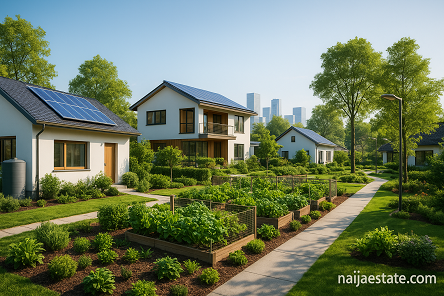
green-building estate developments in Lagos suburbs in 2025
If you dey look for property in Lagos suburbs, but you no just want any house — you want something green, future-proof, and friendly to Mother Earth — then this blog post is for you. In 2025, green-building estate developments in Lagos suburbs are no longer pipe dreams. More developers are going sustainable, combining eco-friendly design with Lagos lifestyle.
In this post, I go break down what green-building estates are available in Lagos suburbs this year, why they matter, how they’re built, what benefits they bring, and what challenges remain. Whether you’re an investor, homebuyer, or just curious about the shift in Lagos real estate, you go get value from here.
Why Green-Building Estates Matter in Lagos
Environmental Pressure & Urban Growth
Lagos is growing like mad — more buildings, more people, more energy demand. But with growth comes stress: heat, flooding, pollution. According to geotechnical experts, Lagos urgently needs sustainable construction to address climate risk and reduce energy use.
Green-building estates help with:
Reducing carbon footprint through energy-efficient design.
Saving water via rainwater harvesting and efficient plumbing.
Providing better air quality with green spaces, landscaping, and sustainable materials.
Rising Demand & Investor Interest
Green real estate isn’t just for tree-huggers — savvy buyers and investors know that sustainable homes often save money long term. As more people in Lagos suburbs wake up to environmental issues, they also want value. Plus, eco estates help developers stand out.
Policy & Certification Push
Some green estates in Nigeria are EDGE-certified, which means they meet internationally recognized efficiency standards. The African Cities Research Consortium reported Peridot Estate in Badagry is EDGE certified, achieving big energy savings.
Regulators and urban planners now see green construction as not just “nice to have” but essential.
What’s New in 2025: Key Green-Building Estate Developments in Lagos Suburbs
Let’s dive into the specific green-building estate developments in Lagos suburbs you should know about in 2025. These are not mere plans — some are launched, some in progress, and others very near completion.
1. Emerald Haven (Meritabode, Lekki–Epe Corridor)
One of the standout sustainable estates this year is Emerald Haven, by MeritAbode Nigeria Limited, located in the Lekki–Epe corridor.
Highlights:
Size & Scope: 25-acre mixed-use estate, 150 plots, 100 open for development now.
Design & Zoning: Residential, commercial, and creative zones. This is very “live-work-play” — you can build your dream home, set up small business or even have an artistic studio.
Green Infrastructure: Landscaped parks, green recreation spaces, and smart technology integrated into homes and communal facilities.
Smart Features: Smart home capability (internet, security), high-speed connectivity, CCTV, 24-hour security.
Sustainability: The developers talk about “sustainably planned” – with energy efficiency, reduced environmental footprint, and infrastructure designed to last.
Why It Matters:
Emerald Haven is a strong signal that mainstream developers are embracing sustainability—not just in architecture, but in how communities are planned. If you buy here, you’re not just getting a plot; you’re investing in an estate designed for the future.
2. The Emerald Estate (Springpet Homes)
Springpet Homes has unveiled The Emerald Estate, a bold green-initiative estate in Lagos with a sustainability-first vision.
What Makes It Special:
Tree-Planting Initiative: They pledged to plant 1,300 trees inside the estate and its surroundings.
Solar Infrastructure: Solar-powered common infrastructure, reducing reliance on the erratic grid.
Leisure & Community Spaces: Landscaped communal areas, swimming pool, gym, and secure, well-planned layout.
Certification & Legitimacy: Comes with a Certificate of Occupancy (C of O), giving buyers long-term confidence.
Why It Matters:
By planting so many trees and committing to solar, Springpet Homes is not just building houses — they’re building a legacy. For middle- to upper-income buyers who care about sustainability and future resale value, The Emerald Estate is very attractive.
3. Mowe Golf Town (MGT)
Though not strictly in Lagos State, Mowe Golf Town (MGT) is too relevant to ignore because of its sustainability mission and proximity to the Lagos real estate ecosystem.
Key Features:
Sustainable Design: Eco-friendly homes; “Green Residence & Resort” bungalows planned.
Affordable Plots: Serviced plots for buyers.
Eco Materials: Use of innovative, energy-efficient building materials through lead contractor Moulding Technologies Ecobuild.
Long-Term Vision: A full integrated community — residential, commercial, golf course — with sustainable infrastructure at its heart.
Why It Matters:
MGT shows that green building is not just for high-end gated estates. Even more affordable, mixed-use developments are embracing sustainability. For Lagos-based investors, MGT offers a way to participate in green living without necessarily paying a premium Ibiza-island price.
4. Peridot Parkland Estate, Badagry
This one is close to Lagos suburbs and has made big waves in sustainable development. Peridot Parkland Estate, by Echo stone Development, is Nigeria’s first EDGE-certified housing estate.
What Makes It Green:
EDGE Certification: Means real, measurable energy, water, and carbon savings.
Efficiency Stats: The homes are designed to deliver ~53% energy savings, ~42% water savings, and ~35% carbon footprint reduction.
Materials and Design: Insulated walls, low-flow plumbing, reflective roofing, shading devices — all tailored to Lagos climate.
Community Green Spaces: Includes green parks, shared amenities, and sustainable infrastructure to boost residents’ quality of life.
Why It Matters:
Peridot Parkland is a concrete example (pun intended) of what “green suburb living” can look like in or near Lagos. For eco-conscious buyers, this is one of the few estates where sustainability isn’t just a marketing label — it's built into the very bones of the homes.
5. Afriland Estate (Karmo)
Afriland Properties is also pushing the sustainable conversation in real estate. At the 2025 Lagos Real Estate Fest, they highlighted their development of Afriland Estate, Karmo, with green and community-led elements.
Estate Features:
Mix of apartment types: 2- to 4-bedroom units, terraces, semi-detached.
Green spaces integrated into the design, not just as an afterthought.
Alternative power systems: emphasis on energy resilience.
Smart connectivity: modern infrastructure that supports a 21st-century lifestyle.
Why It Matters:
Afriland is a respected name in Nigerian real estate. Their building this green-focused estate is more proof that sustainability is not fringe — it's becoming central to how major players think about the future.
Broader Trends Behind These Developments
Now that we’ve seen the estates themselves, let's explore the wider trends driving this green shift in Lagos suburbs.
1. Sustainability Is Becoming Mainstream
Green building is no longer some esoteric, luxury-only niche. Experts like Stephen Adeniyi argue that with climate pressure (flooding, heat, pollution), Lagos must adopt green construction.
As developers and buyers tick “eco-friendly” off their priority list, more green estates are emerging.
2. EDGE Certification & Efficiency
EDGE (Excellence in Design for Greater Efficiencies) is gaining prominence in Nigeria. The certification encourages energy-saving design, efficient water usage, and lower emissions. Peridot Parkland is a strong example.
This gives real, measurable credibility to “green estate” claims — not just buzzwords.
3. Government and Public Support
Sustainable development isn’t just about profit. Some voices in Lagos real estate are calling for more support: for instance, Collins Clifford has advocated for subsidized land allocation for developers who commit to green projects.
When public policy aligns with green goals, it accelerates adoption.
4. Smart Infrastructure Integration
Modern green estates are not just green in construction — they are “smart”: integrating power, security, internet, and communal design in one package (Emerald Haven is a prime example).
Smart-living and green-living are merging into a cohesive suburban lifestyle.
5. Affordability & Legacy Value
It used to be that green = very expensive. But estates like Mowe Golf Town show that eco-friendly living can be more affordable.
Plus, because green homes often cost less to run (energy, water), they offer strong long-term returns for buyers and investors.
Challenges & Risks to Watch
As exciting as these green-building estate developments are, they don’t come without hurdles. Here’s what to watch out for — especially if you’re thinking of buying into one.
A. Cost of Green Construction
Even with long-term savings, green building materials (insulated walls, reflective roofing, efficient plumbing) can drive up initial costs. This may limit how “green” some developers go, especially when targeting mid-market buyers.
B. Infrastructure & Maintenance
Green estates often require ongoing maintenance: solar panels, water harvesting systems, landscaped green spaces. Without proper upkeep, the sustainability promise could falter.
C. Regulation & Certification Complexity
Getting EDGE certification or other green credentials is not easy. Plus, regulation in Nigeria may not always support or enforce green building standards robustly. If policy incentives are weak, some developers may not prioritize green features deeply.
D. Buyer Awareness
To many buyers, “green” can still feel abstract or like marketing. Without education — on what green building means, how much it saves, and why it’s valuable — uptake may be slower.
A Reddit user pointed out a more basic problem:
“If there isn’t some massive centrally planned housing initiative … a general increase in architectural knowledge throughout the country would be permanently beneficial.”
That kind of awareness-building is critical.
E. Land Access and Government Support
Land in Lagos suburbs is very valuable. For green projects to scale, developers may need support from government (e.g., in land allocation, zoning, tax incentives). Without that, green estates risk being niche.
My Commentary & Real-World View (As a NaijaEstate Journalist)
From where I sit, 2025 feels like a turning point for green-building estates in Lagos suburbs. Here's why I'm optimistic — but also cautious.
Why I'm Optimistic
More Developers Taking Green Seriously
The fact that developers like Springpet Homes and MeritAbode are launching green-first estates shows this isn’t a fad. Their commitment is real — trees, solar, and smart design prove it.
EDGE Certification Adds Credibility
With certified projects like Peridot Parkland, buyers can trust that “green” isn’t just marketing. There is real, measurable efficiency.
Policy Conversations Are Happening
When people like Collins Clifford call for subsidized land for sustainable developers, that shows some alignment between public and private goals.
Long-Term Value for Buyers
Green homes could save residents money on power and water. For families or investors planning to stay long-term, that’s very attractive.
What Concerns Me
Maintenance Risk: What if solar panels break, or water harvesting systems aren’t managed well? These systems need upkeep, otherwise the “green” promise weakens.
Affordability Gap: Will truly sustainable estates remain out of reach for middle-income Lagosians who need them most?
Regulatory Inconsistency: Without strong enforcement or incentives, green building may remain the domain of a few developers.
Awareness Deficit: Many buyers still don’t fully understand what green-building means or why it's valuable — education is key.
What to Look for If You Want to Buy in a Green-Building Estate in Lagos
If you’re considering buying into a green estate, here are practical tips (from my real estate reporting and experience):
Ask for Certification
Request to see EDGE certification or equivalent proof of sustainability. Don’t just take marketing brochures.
Check Infrastructure
Confirm whether solar panels, rainwater harvesting, and energy-efficient features are installed already, or are just “planned”.
Understand Maintenance
Who will maintain communal green infrastructure? Is there a management company? What are the charges?
Look at Long-Term Costs
While your upfront cost might be higher, estimate your monthly energy and water savings. Green homes often pay back over time.
Verify Title & Legal Position
As with any real estate deal, verify titles, zoning, and approvals. Make sure the estate is legally approved and that green features are part of the title documents or development plan.
Talk to Residents / Early Buyers
If possible, chat with people already living in the estate. They can give you ground-level insight into how “green” the community really is.
Check for Future Expansion
Confirm whether there are phases planned. Sometimes, “phase 1” is green, but later phases may cut corners.
The Broader Impact: Why Green Estates Will Reshape Lagos Suburban Living
Let me take a step back and look at the bigger picture: Why green-building estates in Lagos suburbs matter — not just for buyers, but for the city and the nation.
Building a Sustainable Real Estate Ecosystem
If green estates scale, Lagos could become a model for sustainable urban sprawl in Sub-Saharan Africa. Rather than just more concrete, we’d see:
Eco neighborhoods with real green space
Smarter, energy-efficient homes
Communities that plan for climate resilience (heat, flooding, water stress)
Wealth Preservation & Long-Term Value
Green homes are likely to retain value better over time. As the cost of energy rises and climate risk intensifies, homes built with efficiency baked in will be more valuable.
Social Impact & Wellbeing
Green estates often improve quality of life:
Cleaner air, thanks to more trees and less heat absorption.
Better outdoor spaces encourage more exercise and community interaction.
Lower utility bills mean more disposable income for residents.
Policy & Market Incentive Shift
As more green estates emerge, policymakers may strengthen incentives: tax breaks, green mortgage products, or subsidized green land. Investors, seeing potential, may also back more sustainable projects.
Conclusion
Green-building estate developments in Lagos suburbs in 2025 are not just “nice to talk about”—they’re happening. From Emerald Haven in Lekki-Epe to The Emerald estate by Springpet Homes, Mowe Golf Town, and Peridot Parkland Estate, the shift to sustainable suburban real estate is very real.
These estates bring environmental benefits, long-term financial value, and a quality of life upgrade. But the road is not free of bumps: maintenance, cost, regulation, and awareness all pose challenges.
If you’re ready to buy into a green estate, do your homework—ask for certifications, inspect infrastructure, and think long term. This isn’t just property; it’s part of Lagos’s future.