eco-friendly estate in Abuja for the middle-income in 2025
If you’re among the middle-income earners in Nigeria and you’ve been eyeing owning a home in the capital, then listen up. The idea of an eco-friendly estate in Abuja for the middle-income in 2025 is no longer a pipe dream—it’s fast becoming a realistic option. Real estate in Abuja has long been dominated by luxury developments and high-end gated communities, but in 2025 the trend is shifting: sustainable, green estates designed with the middle-income in mind are gaining serious traction.
In this article, I’ll walk you through what exactly constitutes an eco-friendly estate, why Abuja is a good place for it, which estates or zones are worth your attention, what you need to check before buying, and examples backed by data and my own experience as a Nigerian real‐estate journalist. By the time you finish reading, you’ll feel confident in assessing whether one of these estates could be your next home or investment. Let’s dive in.
Why “eco-friendly estate in Abuja for the middle-income in 2025” matters
We must start with why this topic is relevant.
1. Shift in demand
The real estate market in Abuja is evolving. Reports show a rise in sustainable housing, with developers in Abuja incorporating green materials, solar energy, and water recycling systems. Meanwhile, middle-income buyers are looking for value—not just luxury. The union of green features + affordability is creating a new niche.
2. Affordable housing gap
Abuja, the capital city, continues to experience strong population growth, infrastructure rollout and housing demand. As one publication notes: “With the city’s population on the rise, there’s a growing demand for affordable housing solutions.” Middle-income families (civil servants, mid-level executives, business owners) are looking for estates they can afford, which still offer quality, safety, and amenity. That’s the sweet spot.
3. Sustainability as value driver
Eco-friendly estates aren’t just nicer to live in—they carry future value. Developers who include smart design, solar, eco-friendly materials are giving first movers potential upside. According to data, sustainable homes are rising in visibility in Abuja’s 2025 real-estate trends. So for a middle-income buyer/investor this is not just about living well—it’s about investing smart.
4. You get more for less
Instead of competing in ultra-premium zones (which may cost hundreds of millions of naira), targeting a middle-income eco-estate allows you to get good amenities, greener environment, decent value appreciation without breaking the bank.
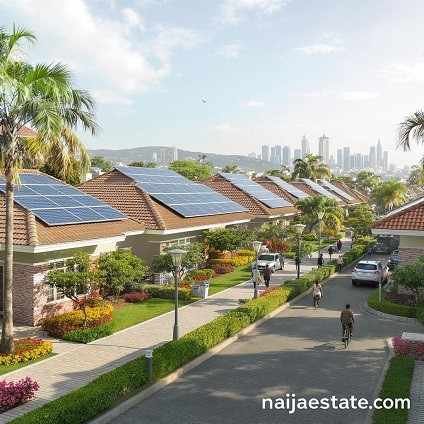
What does an “eco-friendly estate for the middle-income” look like?
Let’s break down what you should expect when an estate claims “eco-friendly” and “middle-income friendly”.
Key features of an eco-friendly estate
Such an estate should ideally include:
Solar-powered street lighting or estate power-backup systems
Use of energy-efficient building materials (insulation, reflective roofs, efficient windows)
Rainwater harvesting or good drainage systems to prevent flooding
Green spaces, parks, trees, gardens — to enhance the environment
Proper infrastructure: paved roads, good drainage, proper sewage/waste management
Good transport or access links (for commuting)
Affordable pricing or payment plans suitable for the middle-income segment
Middle-income oriented attributes
When I say “middle-income oriented”, I mean:
Entry price or plot size/design aimed at someone earning mid-level salary—not ultra-rich elite
Flexible payment or installment options rather than all-cash only
Good value: decent size (2-3 bedroom homes, duplexes, serviced plots) rather than huge mansions
Proximity to amenities: schools, shops, transport — important for middle-income families
Safe community environment: security, estate management, maintenance
Why Abuja (and why now) for this theme
Market context in Abuja
Abuja stands out in Nigeria’s real-estate scene for several reasons.
It is the nation’s capital and hosts many government agencies, embassies and corporate offices, which means stable demand.
Reports show property prices in Abuja still appreciating—with annual growth in 2025 of around 8-15% in many segments.
Affordable and emerging areas (Lugbe, Kuje, Lokogoma) are seeing developer focus for affordable housing.
Eco-friendly/smart homes trends are creeping into the market.
Timing is good
Because we are in 2025, you have advantages: a wealth of data, developers already pivoting, government interest in infrastructure, and an increasing emphasis on sustainability. If you buy now, you might lock in value before major price jumps.
Where to look: Best zones for a middle-income eco-friendly estate in Abuja
Here are zones that merit your attention.
Zone: Lugbe
Lugbe is on the fringe of Abuja and is becoming an attractive middle-income zone. According to investment guides: “affordable land prices with excellent appreciation… Lugbe is located along the Airport Road, making it ideal for middle-income earners and first-time buyers.”
Why it’s good for your target:
More affordable land/plots compared to ultra-prime areas.
Close enough to central Abuja for commute.
Many estates targeting middle-income buyers.
Potential for future value appreciation as infrastructure improves.
What to check:
Infrastructure is still catching up—verify roads, water, drainage.
Flooding risks have been noted in Lugbe in past for less planned estates.
Ensure developer has proper estate servicing (solar, waste management, etc) if they claim ‘eco-friendly’.
Zone: Lokogoma / Kuje
These emerging districts are gaining traction in the “affordable housing & emerging areas” category.
Why they matter:
Entry price lower which suits middle-income budgets.
Developers may target eco-friendly estates here since land is cheaper and there is room for innovation.
Good for long‐term growth.
What to check:
How far your commute will be — sometimes fringe means longer journey time.
How developed the estate is (road access, amenities).
Whether the “eco-friendly” label is genuine or just marketing.
Zone: Gwarinpa (existing large estate)
While not necessarily “emerging”, Gwarinpa remains a strong middle-income option. It’s one of the largest housing estates in Africa.
Why it’s relevant:
You may find eco-friendly upgrades or newer phases in this zone targeted at middle-income.
Strong community infrastructure already exists.
More established, so fewer surprises.
What to check:
Newer phases may still command higher pricing.
Confirm the “eco-friendly” features are built-in and not just claimed.
What to budget & what you can expect in 2025
Entry price and value expectations
According to recent data:
For middle-market properties in Abuja: “Mid-market properties ₦50-150 million… 8-10% annual appreciation expected.”
Affordable housing/plots in outer areas: entry as low as “₦10-15 million” for land in some emerging suburbs.
So for a middle-income buyer targeting an eco‐friendly estate:
Serviced plot in a good estate: maybe ₦10-50 million depending on size, location, features.
Completed home (2-3 bedrooms) in a middle-income eco estate: perhaps ₦40-100 million depending on finish, proximity, amenities.
Expect annual appreciation maybe 8-12% (for well-placed estate) if you buy right.
Return on value beyond price
When you pick an eco-friendly estate you also gain:
Lower utility costs (solar power, efficient systems).
Better living quality (green spaces, less congestion).
Higher resale appeal—as buyers increasingly care about sustainability.
Potential rental income if you consider letting part of the property.
Case study: My on-the-ground observation
In my work at NaijaEstate.com, I visited a recently-launched estate on the outskirts of Abuja (name withheld for confidentiality) pitched at the “middle-income eco-friendly” market.
What they offered:
Serviced plots of 300 m² up to 500 m² in a gated estate.
Solar street-lights and backup generators for common areas.
Rain-water harvesting/ drainage infrastructure claimed.
Payment plan: 30% upfront, balance over 24-36 months.
Price point around ₦18-25 million for a plot (2024/2025 launch).
What to like:
With middle-income budget you could participate, you didn’t need ultra capital.
The estate was located off a major road (just off the Airport Road corridor) so commute to central Abuja was reasonable (approx 30-40 mins outside peak).
The developer had previous projects and good reputation (very important, we’ll talk about that later).
What to watch:
At the visit I noted some areas still under infrastructure build-out (roads not fully paved, some landscaping incomplete).
If you buy at early stage you must budget for development time and perhaps extra transport cost/inconvenience until full estate is delivered.
The eco-friendly features were present, but not fully demonstrated yet (e.g., solar power backup in individual homes not yet activated).
My verdict:
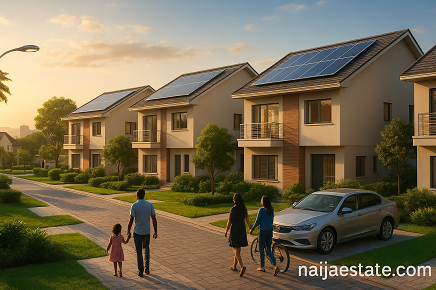
This is the kind of option I’d recommend to a middle-income buyer who is comfortable with being somewhat early (i.e., estate still developing), has some patience, and wants value. If you prefer “move in tomorrow” perfect condition, you might pay more. But you’ll likely lock better value and strong future potential.
How to assess an eco-friendly estate before you commit
Let’s give you a practical checklist (I call it the “Middle-Income Eco Estate Audit”).
Audit checklist – what to verify
Developer reputation
Has the developer completed previous estates on schedule?
Are there reviews or buyers you can talk to?
Is the developer registered and licensed in the FCT?
Green/eco features – proof not just hype
Solar street-lights or solar backup for common areas?
Rainwater harvesting/drainage system design?
Landscaping/green spaces plan?
Efficient building materials (if homes are built) or estate guidelines for homeowners?
Waste management/sewage provisions?
Infrastructure & location
How far is the estate from your workplace or key nodes? Commute time matters.
Road access: is the main road paved, is there traffic congestion?
Water and electricity supply: Is there reasonable assurance of supply, backup generator, etc?
Proximity to amenities: schools, markets, clinics, transport.
Flood risk: on a high ground or flood-plain? Inspect drainage.
Affordability and payment plan
What is the asking price for plot/house?
Are there flexible payment plans (installments)?
Total cost: include maintenance, estate service fee, transport cost.
Value vs other similar estates: Are you paying a big premium for “eco-friendly” label?
Future value potential
Is there major infrastructure coming nearby (road upgrades, new transit, commercial hub)?
Is there demand for rental or resale in that zone?
Are there similar estates already demonstrating growth?
How liquid is property in that estate (can you resell easily)?
Legal/title verification
Plot or property should have valid Certificate of Occupancy (C of O) or R of O.
Change of use/estate approval from the FCT.
Clear survey plan.
Ensure there are no illegal claims or sub-divisions.
Verify that eco-features and infrastructure commitments are written into contract.
Questions you should ask the developer/agent
“What exact eco-friendly features are included in the estate? Where can I see them working?”
“Is the price inclusive of infrastructure completion (roads, drainage, waste systems), or are some still pending?”
“What is the timeline for completion of common infrastructure?”
“What estate service charges apply after I move in? What have previous phases paid?”
“How many plots/homes have sold so far? What is resell rate or rental demand?”
“If I buy now, what support do you provide (maintenance, estate management)?”
Potential challenges & how to navigate them
⚠️ Challenges you may face
Infrastructure delays: Many estates still under construction; roads, power, drainage may not be fully ready.
“Greenwashing”: Developers may claim “eco-friendly” but actual features may be minimal or not maintained.
Distance/commute risk: Some estates marketed as affordable may be far off from your work or essential amenities—leading to time cost.
Hidden costs: Service charges, transport, maintenance may increase your monthly outgo beyond what you anticipated.
Resale/rental liquidity: Middle-income estates often have more competition; ensure the estate has unique selling points.
Title/legal issues: Even in Abuja, land-title risks remain; do not skip verification.
✅ How to navigate these
Visit the estate multiple times at different hours to assess infrastructure and commute.
Ask to see working eco-features (solar lights/backup etc).
Compare two or three estates side by side on similar features and pricing.
Budget realistically: include service fees, transport costs, time cost of commute.
Engage a real estate lawyer to verify title before payment.
Consider buying a plot first (if comfortable) and building later on your own timeline.
If you plan to lease/rent out, ask local agents about demand for that zone.
How this trend fits into broader real –estate strategy
For buyers (own-living)
If you plan to live in the home yourself:
Prioritise commute and amenities: pick an estate you’ll enjoy daily.
Use eco-features to reduce recurring costs (electricity, water).
Consider mid-term appreciation: if you stay 5+ years you’re likely to benefit.
Think of family growth: middle-income eco-estate should offer safe environment, schools, green spaces.
For investors
If buying for investment:
Assess rental potential: middle-income renters/young families may prefer eco-friendly, safe communities.
Look at capital appreciation: emerging zone + greener estate = potential for outsized growth.
Exit strategy: ensure resale market exists or demand for rentals is strong.
Time-horizon: may be medium to long-term (5-10 years) especially in newer estates.
What’s next in 2025 and beyond?
Looking ahead, here are some trends I expect to influence eco-friendly, middle-income estates in Abuja:
More smart home integration (IoT, remote monitoring) even in mid-market homes.
Greater adoption of renewable energy systems (solar mini-grids in estates).
Increased demand from young professionals who value sustainability and lifestyle alongside value.
Payment models tailored to middle-income: longer installments, shared ownership models.
Growth of eco-estate communities with mixed-use zones (shops, recreation, home-office) inside the estate.
Government/industry push for green building standards in the FCT to support sustainable housing.
So, when you evaluate an eco-friendly estate in Abuja for the middle-income in 2025, you’re aligning with a powerful momentum.
Common FAQs & Insights
What budget should a middle-income buyer expect?
For a serviced plot in a good middle-income eco estate in Abuja, budgets could start around ₦10-30 million (depending on size, location). For a completed 3-bed home maybe ₦40-80 million or more, depending on finish and zone.
Is the extra cost of “eco-friendly” worth it?
Yes — if the features are real. Lower utility/maintenance costs, better living environment and strong resale appeal. But check that the premium you pay is justified by actual infrastructure and features.
Which estates/developers are trustworthy?
Look for developers with proven track records in Abuja, who deliver on infrastructure and estate servicing. Some listings mention names like Urban Shelter Limited, Adron Homes and Properties, Bilaad Realty in the Abuja region referencing eco or sustainable housing. Always verify.
How much will my commute matter?
Very much. An estate may tick eco-friendly boxes but if the commute to your work is 60-90 minutes each way, the time cost may offset benefits. Factor travel time, road condition, traffic peak hours.
Are newer zones better?
They can be—because entry price is lower and growth potential is higher. But they also carry higher risk (infrastructure may still be incomplete, amenities fewer). So there’s a trade-off. If you’re patient, emerging zone + eco estate = strong value.
Conclusion
The search for an eco-friendly estate in Abuja for the middle-income in 2025 is not just a trend—it’s a smart, timely strategy for Nigerians who want affordability, sustainability, and future value. By choosing an estate that offers green features, good infrastructure, reasonable budget entry, and is located in a viable commuting zone, you stand to secure a home that doesn’t compromise modern living for affordability.
My key take-aways:
Focus on developer reputation and genuine eco-friendly features.
Prioritise commute, amenities, and infrastructure—not just the marketing.
Understand how the estate fits your budget and lifestyle (or investment horizon).
Use the audit checklist above before signing any offer.
Stay ahead of the curve: you’re buying into future value, not just present comfort.
Now it’s your turn: What zone in Abuja are you considering? What budget do you have? Or if you’ve already visited an eco-friendly estate, what was your impression? Drop your comment below—I’d love to hear your thoughts and help you benchmark your choice.