verified land title in Lagos suburbs 2025
Thinking of buying land in Lagos suburbs this year? You better read this first — because without a verified land title in Lagos suburbs 2025, you could be stepping into a money pit full of legal trouble and flood disasters. In this article, I go deep — as one who has followed hundreds of land deals in Lagos — to show you how to check title authenticity, avoid flood-prone areas, and protect your investment. By the time you finish reading, you’ll have a real, practical checklist to keep scammers and seasonal floods far away from your land-buying plans.
Why “verified land title” matters — now more than ever
The fraudy reality in Lagos land market
If you think buying “a nice plot” is enough, you might be in for a rude shock. As of 2025, Lagos and Ogun States record over 500,000 land scam incidents every year.
You read that right — half a million. Many of these involve fake Certificates of Occupancy (C of O), forged survey plans, or lands under government acquisition being sold illegally.
Even more shocking: according to a 2025 audit by the Lagos State Surveyor-General’s office, about 12% of plots have conflicting registrations.
So, when you read “cheap land in Ajah – buy before price jumps,” know that sometimes that “cheapness” comes from missing documents or legal loopholes. That’s why a “verified land title in Lagos suburbs 2025” is not just a nice-to-have — it’s essential.
Flood risk + environmental danger: the hidden threat
Even if the title is clean, environmental risk can still kill your investment. Lagos has expanded rapidly, often swallowing wetlands, floodplains, and lagoon fronts without proper planning.
Now, with climate change and rising sea levels, floods are becoming more frequent and severe. According to a recent study, many parts of Lagos — especially the suburbs — remain very vulnerable due to poor drainage, weak infrastructure, and loss of natural flood barriers.
That’s why 2025 buyers must think about legal title and environmental safety. A good land title on a flood-prone swamp is still a dangerous bet.
What does “verified land title” actually mean in 2025?
When we say “verified land title in Lagos suburbs 2025,” we mean a plot that ticks all of the following boxes:
Has a registered title (Certificate of Occupancy, valid Deed of Assignment + Governor’s Consent, or valid Excision, where applicable).
Is recorded in the Lagos State Land Registry / EDMS system, with no outstanding encumbrances, liens or government acquisition notices.
Has a legitimate, authenticated survey plan — with coordinates matching physically to the land, verified by the State Surveyor-General’s Office.
Is — as far as possible — free from flood risk, environmental hazards or planned demolition under zoning laws.
If any of these pieces are missing, you don’t have a safe land investment — you have a gamble.
How to verify land title in Lagos suburbs (2025) — step-by-step checklist
Here’s my proven, on-the-ground process that I use whenever I advise buyers (especially diaspora and first-time investors) in Lagos:
1. Demand the real documents — not just “receipt” or “assignment letter”
Many estate agents will show you a “deed of assignment” or a receipt and expect you to pay. That’s a classic red flag. In 2025, you must insist on seeing:
Original Certificate of Occupancy (C of O) or valid Excision / Governor’s Consent where applicable.
Original survey plan (red copy) bearing Surveyor-General’s stamp, plan number, and precise coordinates.
The seller’s Government-issued ID (passport, NIN, or driver’s licence) whose name must exactly match the name on the title documents.
If they can’t show these — walk away.
2. Visit the Lagos State Land Registry (Alausa, Ikeja) — or use EDMS
In 2024–2025, the Lagos State Lands Bureau has continued to digitalize its records. Over 60% of land titles were reportedly registered digitally — up from just 25% in 2022.
At the Land Registry you want to:
Conduct a title search using the plot number or survey plan number.
Check for any encumbrances: mortgage, caveat, court case, government acquisition notice, unpaid ground rent, etc.
If all is clean, get a Certified True Copy (CTC) — not just a photocopy from the agent. The CTC from the Registry is the gold standard.
This search typically costs between ₦10,000–₦50,000 and can take 2–14 days depending on the complexity of ownership history.
3. Cross-check with the Office of Surveyor-General
Even if title search is clean, that doesn’t guarantee the land on the ground matches the plot in the registry. That’s why you must:
Ask the Surveyor-General’s office (or a licensed surveyor) to authenticate the survey plan number.
Have them confirm that the coordinates on the plan correspond to actual GPS coordinates on ground.
If possible, pay for an independent site survey (cost for this can be from ₦50,000 to ₦100,000 depending on size).
This step helps catch many cases where the same “title” is used to sell multiple plots (double sales) — a big fraud scheme in Lagos.
4. Get Governor’s Consent (if not already) & Clear Ground Rent
Under the Land Use Act 1978, all land sales must obtain Governor’s Consent. Without it, even a “perfect” C of O can be challenged.
Also, ask for Ground Rent Clearance Certificate — especially in highbrow areas like Ikoyi, where many properties have unpaid ground rents stretching over years.
If these are not cleared before you buy — you might inherit back taxes or even risk revocation later.
5. Check zoning, planning status and flood risk
Because Lagos is rapidly urbanizing — often informally — it’s crucial to check:
Whether the land is in a zoned area or under approved layout (via LASPPPA or local planning authority). Many “estates” in Ibeju-Lekki or Ajah have been flagged for non-compliance.
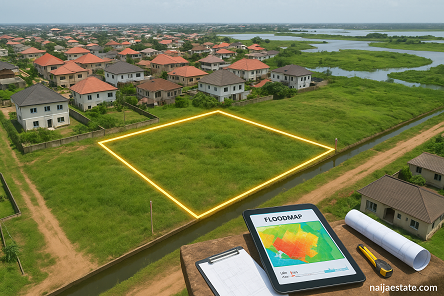
Use Lagos Floodmap (launched late 2025) — a handy proptech platform that allows you to paste any address and get a flood-risk rating instantly.
If near wetlands, lagoon fronts, low-lying areas, or known drainage channels — factor in high flood risk. Studies now show the city has lost large portions of its natural flood-buffer wetlands in recent decades.
If the risk is too high — either avoid or pay much less.
6. Engage a qualified real estate lawyer (and licensed surveyor) — not just an agent
Never rely solely on an agent’s word. Many agents in Lagos are unlicensed, or only interested in quick commissions.
A good lawyer will help:
Verify title documents, survey plans, and Governor’s Consent.
Draft a proper Deed of Assignment / Transfer document.
Handle payment through formal channels (escrow, lawyer’s trust account).
Safeguard you against double sales, forged documents, or last-minute claims from “omo-onile” (land-owning families).
Also hire a licensed surveyor to re-confirm boundaries — especially if plot is irregular, large or in a high-risk area.
Why many buyers fail — and what I’ve seen go wrong in real life
From my years reporting real estate deals in Lagos for NaijaEstate, I’ve seen many people lose millions — even tens of millions of naira — because they ignored one or two of the steps above. Here are common scenarios:
1: The “Agbero Estate” in Ibeju-Lekki
A friend of mine, “Uche,” bought a 500sqm plot in Ibeju-Lekki late 2024. The estate was being sold like “tomatoes and pepper” — flashy ads, free generator, “free road tar on completion,” Instagram-worthy visuals. Price was attractive: about ₦4.2M.
They gave him a “Deed of Assignment” and “Estate layout map.” He paid 50%. A few weeks later, he visited Land Registry — and the plot number did not exist. The survey plan was fake (wrong coordinates). When the developer tried to rush him to pay balance, he refused. End result: he got a refund, but lost about ₦300,000 in initial fees, transport, lawyer consultations, and hassle.
If Uche had used the checklist above (survey verification + registry search), he’d have dodged a scam.
2: The Lekki Lagoon Plot — title good but flood disaster
Another investor, “Ngozi,” bought a plot in Lekki Lagoon area early 2025. She saw a clean C of O, got Governor’s Consent, had documents checked by lawyer, everything looked legit. She started building a bungalow.
Come August 2025 heavy rainfall — Lagos flooded them hard. Water entered the foundation trenches, destroyed building materials, delayed construction by 6 months, cost extra ₦1.2M in lost materials, temporary accommodation, and reinforcement works.
The land title was clean — but nobody bothered to check flood risk or environmental history. If she had used Lagos Floodmap or done soil/drainage tests, she might have reconsidered or negotiated a lower price.
3: The “Family Land” turned double-sale nightmare
A middle-aged couple I know bought a “family land” in Alagbado — meaning the seller got authority from a family head. All documents looked fine. Survey plan, Deed of Assignment, even ground rent clearance.
But they didn’t get Governor’s Consent, and they did not do a formal registry search (they trusted the family). A year later, another buyer surfaced with documents for the same land — claiming it belonged to a different branch of the family. Legal fight ensued. The court eventually ruled in favour of the second buyer because of better documentation, and the couple lost the land — and their money.
This highlights why even “family lands” must be registered properly, with C of O + Consent + Registry search.
What’s new in 2025 — and why this is the smart time to be extra careful
Digital land registry + proptech tools are rising
Thanks to Lagos’ push for digital transformation, the Land Registry is gradually migrating to online, searchable databases (EDMS). As of mid-2025, over 60% of titles are digitized.
Also, proptech firms — like LandCheck, Naijaverify, Sytemap — are gaining ground. They offer services to:
Verify ownership records
Check whether a land is under acquisition or disputed
Confirm survey plan validity
Provide risk reports (flood, dispute, government planning) before you pay any naira.
This is a major win for buyers — for the first time, you don’t have to rely solely on physical registry visits or word-of-mouth.
Increased enforcement against illegal estates and flood-prone developments
In September 2025, Lagos State Government publicly warned estate developers against non-compliance with land-designation regulations. They flagged 176 “illegal” estates operating on unapproved layouts — many in Ibeju-Lekki, Ajah, and other suburban areas.
At the same time, overzealous reclamation, conversion of wetlands, and building in floodplains have led to increasing calls for stronger environmental enforcement.
As a buyer now you’re under more pressure – but also have more reason to demand compliance and transparency.
My practical 2025 “Verified Land Title + Flood Risk” checklist — what you do (yes, you, reader!)
Use this whenever you are considering a plot in Lagos suburbs:
Request original documents (C of O / Excision / Governor’s Consent, survey plan) + seller’s valid ID.
Hire a lawyer (not just an agent) and formally instruct them to carry out:
Title search at Lagos State Land Registry (get CTC)
Ground rent clearance check
Engage a licensed surveyor to validate survey plan — confirm coordinates on ground.
Use digital verification tools / proptech (LandCheck, Naijaverify, Sytemap) for quick background check.
Paste the land address into Lagos Floodmap (or equivalent) — get flood risk rating.
Visit the site physically — see road access, drainage, elevation, neighbours.
Check planning and zoning status with LASPPPA / local authority — especially if you plan to build.
Avoid “promo pressure” — do not give deposit until all checks are clear.
Pay through lawyer escrow or official bank transfer — no cash handover to agents.
Keep all receipts and official proofs — stamp duty receipts, consent stamps, registry CTC, survey certificates, payment proofs.
If any of these steps fail — treat the land as toxic until proven otherwise.
Why this matters for the average Nigerian (especially diaspora and first-time buyers)
Diaspora investors: Many of you buy from abroad or via agents, sometimes even without seeing the land. That’s a major red flag — the moment you see “cheap plot, 5 mins to Lekki freeway, pay now” on WhatsApp or Instagram, put down your phone and demand proof.
First-time buyers: ₦4–6 million may look like a small amount for a plot, but losing that money to fraud or flood would hurt more than skipping a weekend holiday.
Long-term investors: Even if you plan to hold the land for many years, you don’t want it to cost you thousands (or millions) in legal battles, ground rent, flood damage or eviction by the state.
When you buy with a verified land title in Lagos suburbs 2025, you buy peace of mind — not just land.
What to do if you already bought a land — but want to verify it now
Let’s say you already signed and paid — but you didn’t do full verification. Don’t panic yet. You can still salvage the situation:
Visit the Land Registry ASAP and request a post-purchase title search + CTC.
Hire a licensed surveyor to confirm the boundaries and coordinates.
Check for ground rent or unpaid land fees — those can be paid retroactively.
Use the Lagos Floodmap to check environmental risk — if the area is red-flagged, you may consider selling, building with flood-proof design (piling, drainage), or negotiating a discount.
If you find red flags — consult a lawyer immediately. In many cases, you may still have legal provisions to cancel or renegotiate purchase, especially if seller misrepresented facts.
Why I believe “proptech + careful buyer” will win in Lagos 2025
From my reportage and observations, 2025 looks like a turning point:
The digitalization of land registry and increased use of platforms like LandCheck, Naijaverify, Sytemap are reducing the dominance of shady agents and fake documents.
Government is increasingly cracking down on illegal estates and unapproved developments, especially in high-risk flood zones — making compliance more valuable than ever.
Buyers (especially diaspora and first-time) are becoming more aware — thanks to real estate blogs, social media, and even community discussion boards (Reddit, WhatsApp groups). I see more people asking “Which checks should I run?” before signing. That’s a good sign.
In short: the tools are now there. The question is — will you use them?
Conclusion
If you plan to invest in Lagos suburbs in 2025, “a pretty picture on Instagram + small price” should never be enough. You need a verified land title in Lagos suburbs 2025 — complete with clean registry records, authentic survey plan, Governor’s Consent, and flood-risk assessment.
Doing due diligence may cost you extra — lawyer fees, surveyor fees, registry search fees — but compare that to the cost of losing ₦4M–₦6M (or more) to fraud, legal battles, or environmental disaster. It is nothing.
Lagos land market is like Lagos traffic — chaotic, risky, but with some direction and caution you can reach your destination safe and sound.
If you’ve experienced land buying in Lagos — good or bad — drop your story in the comments. Your experience could help someone avoid tears and stress.
And if you want to follow more Nigerian real estate news — check out our news section.
Happy (and safe) land buying!